GFS Pride sinks as Hormuz attacks slow oil shipments
GFS Pride sank after a Hormuz attack as escalating strikes reduced oil shipments and widened risks for commercial shipping.
- Debate level · 58 / 100 mixed
- Source tone · 78 / 100
Debate level shows how sharply the positions reported in a story conflict. Source tone shows how much of our account rests on checkable facts and on-record quotes rather than interpretation. Both are scored by our model from our account of the coverage, out of 100, as in the app.
Based on reports up to .
New here? Turn on Claims Mode to see where each claim comes from.
Claims Mode is on. Select any highlighted passage to see the reporting behind it.
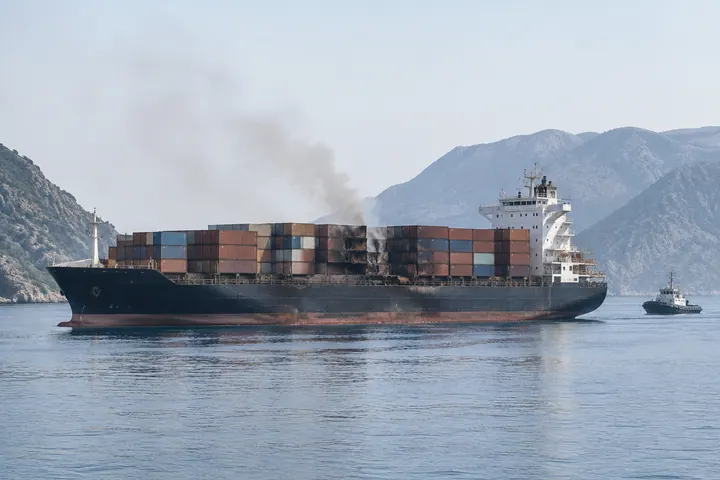 AI illustration
In a rush? Get the brief
- The Singapore-flagged container ship GFS Pride sank after an attack in the Strait of Hormuz; all 21 crew members were evacuated unharmed. Another Singapore-flagged ship was damaged, while attacks have disrupted shipping and reduced oil flows.
- Iran says GFS Pride hit a naval mine on an unauthorized route, but UKMTO and maritime-security sources say it was struck by an unidentified projectile and find no independent evidence of a mine. Officials also differ over Iran's ability to control or close the waterway.
- The attacks threaten a major global oil and LNG route, raising shipping and insurance costs and contributing to higher oil prices, which could affect energy and goods costs.
- Commercial traffic is likely to continue with U.S. and regional protection, but further attacks could deter more operators, deepen oil-flow disruptions and potentially expand risks toward the Gulf of Oman.
The key facts, in one minute. Turn on Claims Mode to see who reported each claim, here or in the app. Get the app
In this story · 5 parts
GFS Pride sinking and other vessel attacks
Singapore's Maritime and Port Authority said the Singapore-flagged container ship GFS Pride had sunk after an attack in the Strait of Hormuz. All 21 crew members were evacuated with no injuries reported. The vessel sustained damage and an onboard fire. The cause of the sinking remains disputed.
Iran's Revolutionary Guards said the ship hit naval mines while using a route they called unauthorised. By contrast, UKMTO and maritime-security reporting described a strike by an unidentified projectile, while Marisks said there was no independent evidence that a mine caused the sinking.
Marisks said it viewed Iran's mine account as a psychological operation aimed at spreading fear and uncertainty and discouraging commercial shipping. The Maritime and Port Authority condemned the attacks on commercial vessels as unprovoked, unjustifiable and a breach of international law.
The authority said another Singapore-flagged vessel, GFS Giselle, suffered hull damage after being struck but reached safe anchorage. No crew injuries were reported aboard that vessel.
The attacks followed the September 23 projectile strike on the Antigua and Barbuda-flagged bulk carrier Cape Dao near the Strait of Hormuz. Maritime officials later reported that the vessel sank weeks afterward. One crew member was killed in the strike, and the rest of the crew were evacuated immediately afterward.
A broader shipping threat
Marisks said the threat had expanded beyond tankers to container ships and bulk carriers, exposing a wider range of commercial trade to serious damage. Before this escalation, the Strait of Hormuz carried about one-fifth of global oil and liquefied-natural-gas trade. Kpler attributed reduced crude shipments through the strait to the increased rate of attacks. Reuters reported that shipping and insurance costs, alongside continuing attack threats, were complicating efforts to restore normal traffic through Hormuz.
Switching off tracking devices does not provide effective protection, Marisks said. Its assessment was based on three vessels struck by unidentified projectiles that it confirmed had been navigating with their trackers off. It described the threat to merchant ships as indiscriminate and highly unpredictable. Three ships struck that week were operated by the same firm, which Marisks said raised concerns about possible operator-linked targeting.
Iranian escalation and U.S. military assessment
Reuters reported that two senior Iranian officials said Iran was deliberately escalating and adapting its attacks, changing both their type and pace. The officials said the aim was to frustrate U.S. and allied efforts to bring down global oil prices and influence the environment for the U.S. midterm elections.
The officials said Tehran intended to expand operations beyond the strait. One unnamed senior official predicted that the passage would soon be completely closed to vessels Iran considered to be violating its restrictions.
A U.S. military official said the IRGC had begun using unarmed spotters in small boats to identify potential targets, including U.S. naval vessels. The official assessed that Iran had been unable to prevent an increase in oil exports.
Drewry Maritime Advisors said Khorfakkan and Sohar had become critical gateways for Gulf cargo after wider container networks avoided Hormuz. Jayendu Krishna, a maritime adviser, warned that escalation into the Gulf of Oman could threaten alternative ports and cut off a significant share of supplies to Gulf countries.
Oil flows and market pressure
U.S. Central Command said American forces and regional partners controlled the Strait of Hormuz and that commercial traffic continued to pass through the waterway with coordinated protection by American forces and regional partners. Kpler's estimate, however, showed that continued passage had not returned oil flows to their level at the end of September.
Amid the wider escalation, Brent crude reached an intraday high of $110 (£82.59) a barrel, its first such level since May. U.S. West Texas Intermediate rose 3.5% to settle at $101.41 (£76.14) a barrel.
CNBC's analysis attributed upward price pressure partly to the attacks and possible supply disruption, while noting that inventory conditions also contributed to market movements.
Despite reduced flows and higher costs, maritime experts including Collin Koh expected commercial shipping to continue transiting the strait, while warning that further attacks could deter more operators. They cited strong Asian demand for Middle Eastern oil, lucrative voyages and operators' willingness to accept higher costs and risks.
Sources
15 reports from 9 outletsFrom CNBC, BBC, Reuters and 6 more
CNBC4
- Container ship sinks in Strait of Hormuz as Iran steps up attacks (opens in a new tab)
- U.S. crude oil near $98 as Iran steps up attacks in Strait of Hormuz (opens in a new tab)
- Brent oil touches $110 as Iran escalates Hormuz attacks, Ukraine vows to hit Russian refineries (opens in a new tab)
- One Singapore ship was sunk, but here's why others are still transiting the Strait of Hormuz (opens in a new tab)
BBC2
Reuters2
The Independent2
CBS News
Financial Times
Nature
New York Times
The Guardian
How this story was made. Drafted with AI from 15 reports by 9 outlets. Each highlighted line in Claims Mode links to the reporting behind it. Debate level shows how sharply the positions reported in a story conflict. Source tone shows how much of our account rests on checkable facts and on-record quotes rather than interpretation. Both are scored by our model from our account of the coverage, out of 100, as in the app. How we make stories · Corrections · Spotted an error? Tell us
More to read
US and Iran Resume Military Strikes
A renewed US-Iran military exchange has brought regional missile retaliation, disputed civilian-casualty and maritime claims, shipping insecurity, competing diplomatic strategies and forecasts of significant economic consequences for UK households.
Trump Rejects Iran’s Hormuz Reopening Proposal
Donald Trump rejected Iran’s offer to reopen the Strait of Hormuz in exchange for lifting a US naval blockade, removing oil sanctions and restoring a regional ceasefire. Iran says it remains willing to negotiate through mediators, while US officials and allied voices argue that Tehran’s conditions are unacceptable. The dispute has left energy markets strained, exposed sharply different views on sanctions and military pressure, and kept Qatar-led indirect diplomacy alive but uncertain.
Russian Strikes Leave Ukrainians Without Power
Russian attacks leave at least 600,000 without electricity as Kyiv disputes ceasefire claims and questions allied warnings.