Russian strikes damage Ukrainian energy facilities amid ceasefire dispute
Russian attacks leave at least 600,000 without electricity as Kyiv disputes ceasefire claims and questions allied warnings.
- Debate level · 68 / 100 contentious
- Source tone · 85 / 100
Debate level shows how sharply the positions reported in a story conflict. Source tone shows how much of our account rests on checkable facts and on-record quotes rather than interpretation. Both are scored by our model from our account of the coverage, out of 100, as in the app.
Based on reports up to .
New here? Turn on Claims Mode to see where each claim comes from.
Claims Mode is on. Select any highlighted passage to see the reporting behind it.
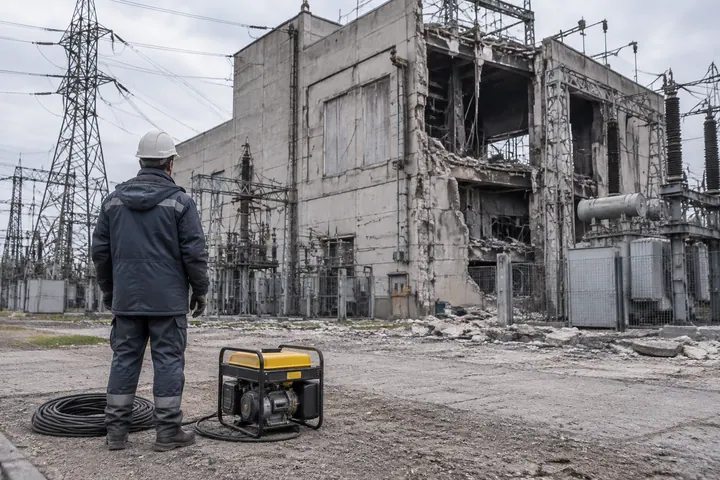 AI illustration
In a rush? Get the brief
- Russian missiles and drones damaged 30 Ukrainian energy facilities on October 13, cutting power to at least 600,000 people; a Kyiv power plant and residential building were hit, causing one death and 13 injuries.
- The central dispute is whether an energy ceasefire exists: Trump said Russia and Ukraine agreed to one, but Moscow did not confirm it and Zelenskyy said Ukraine was unaware of any deal. Kyiv also raised concerns over insufficient air-defense ammunition and missing allied missile warnings.
- The attacks deepen risks of electricity, heating and hot-water outages ahead of winter, while limited missile interception capacity leaves civilians and infrastructure vulnerable.
- Ukraine is likely to seek more Patriot ammunition, air-defense packages and reliable intelligence warnings, while Russian strikes on energy infrastructure and disagreements over a ceasefire are likely to continue.
The key facts, in one minute. Turn on Claims Mode to see who reported each claim, here or in the app. Get the app
In this story · 6 parts
October 13 barrage and ceasefire dispute
Russian missiles and drones damaged 30 energy facilities in an hours-long October 13 attack, leaving at least 600,000 people without electricity, President Volodymyr Zelenskyy said. The attack primarily targeted Kyiv and Kharkiv and came as Russia has particularly stepped up attacks on Ukraine’s energy infrastructure ahead of the winter.
Ukrainian authorities reported intercepting just four of the 39 missiles launched in the October 13 attack.
Associated Press reporting said Ukraine lacked sufficient Patriot ammunition and could not stop Russian ballistic missiles without an adequate supply.
The October 13 barrage came amid a dispute over an energy ceasefire. Donald Trump announced that Moscow and Kyiv had agreed to an energy ceasefire. Russia had not confirmed such an agreement, and Zelenskyy said the announcement was news to him.
After Trump’s announcement, Ukraine reported that the October 13 barrage included strikes on energy infrastructure.
Zelenskyy said Ukraine supported an energy ceasefire but argued that Russia’s continuing attacks on power infrastructure showed it had no intention of refraining from strikes. He also said a broader, 60-day ceasefire would allow Ukraine to hold presidential elections.
Russian Foreign Minister Sergey Lavrov rejected giving Ukraine the respite a ceasefire would bring, saying it did not deserve one. He argued that Europe would use a pause to supply Ukraine with new weapons.
Russia’s account and damage in Kyiv
In its account of the October 13 barrage, Russia’s Defence Ministry said it had struck four power plants in and around Kyiv and two in Kharkiv.
The ministry said it launched strikes against Ukrainian military-industrial facilities, logistics centres, railway and port infrastructure.
Zelenskyy said a Russian ballistic strike hit Kyiv’s Darnytska CHP-4 power facility and a residential building. Mayor Vitali Klitschko reported one death and 13 injuries at the apartment block.
Reuters reported that earlier damage to Kyiv’s Darnytska CHP-4 had left more than 1,000 residential buildings without heating and hot water.
Ukrainian strikes inside Russia
Ukraine has also reported attacks inside Russia. Zelenskyy said it struck two oil facilities and a training ground in the Perm, Samara and Astrakhan regions. He described the strikes as responses to Russian attacks on Ukrainians.
Warnings and defence gaps
During the October 13 barrage on Kyiv, Zelenskyy said Ukraine received no early warning from its partners before five Russian ballistic missiles hit civilian infrastructure. Advance allied warnings of ballistic launches can prevent people being killed, he said.
American officials have in the past notified Ukraine so it could use air defences against incoming missiles.
An anonymous senior Ukrainian official told AFP that the United States was helping Russia. Trump denied that intelligence sharing had stopped, saying the United States was helping Ukraine and sharing intelligence.
Kyiv officials cited the absence of missile-launch warnings, reported US threats to halt relevant intelligence and Starlink restrictions as reasons for the accusation. They said those factors reduced Ukraine’s ability to defend against jet-powered drones.
In a separate, more cautious account, The Irish News reported that an anonymous senior Ukrainian official described the missed warning as a failure possibly caused by circumstances such as weather, rather than a deliberate decision.
Zelenskyy also called on Elon Musk to restore Starlink after Kyiv said the service had been slowed. Former Ukrainian defence minister Mykhailo Fedorov subsequently said Starlink’s operation at speeds of up to 160 km/h was being restored.
Zelenskyy called ballistic missiles Ukraine’s greatest air-defence challenge and urged additional defence packages.
Earlier strikes and civilian toll
Earlier, on October 7, Ukrainian officials said an overnight barrage struck Kyiv and at least a dozen other regions. They said it killed at least 21 people, including children. Zelenskyy put the missile count at roughly 70, many of them ballistic; the air force reported about 130 drones, including attack drones and decoys.
In a local casualty update from the same October 7 barrage, Ukrainian authorities said a strike destroyed a five-storey residential building in Pryluky, in the northern Chernihiv region. As rescue operations continued, the State Emergency Service reported that the death toll there had risen to 16, including four children. About 50 people were injured, seven of them children.
On October 10, local officials said five Russian glide bombs struck Zaporizhzhia. They reported at least 20 deaths, including four children, and at least 32 injuries.
The following day, October 11, Ukrainian officials reported six deaths in two cities. Three people were killed at a Kharkiv grocery store, where 20 people were injured.
Ursula von der Leyen accused Russia of deliberately pursuing a strategy of terror intended to make normal life impossible. Ukrainian officials described the campaign as intended to make people fear sleeping, leaving children unsupervised or planning their lives.
Sources
19 reports from 13 outletsFrom BBC, The Guardian, RTE and 10 more
BBC4
- Zelensky condemns 'vile' large-scale Russian attacks that killed 20 (opens in a new tab)
- Russian glide bomb attack on Zaporizhzhia kills at least 20 people (opens in a new tab)
- Russian strikes hit key power plant in Kyiv, Zelensky says (opens in a new tab)
- Watch: Block of flats destroyed in Russian strikes on Ukraine (opens in a new tab)
The Guardian3
RTE2
ABC News
Al Jazeera
Belfast Telegraph
Daily Mail
Shropshire Star
The Economist
The Independent
The Irish News
The Seattle Times
TheJournal.ie
How this story was made. Drafted with AI from 19 reports by 13 outlets. Each highlighted line in Claims Mode links to the reporting behind it. Debate level shows how sharply the positions reported in a story conflict. Source tone shows how much of our account rests on checkable facts and on-record quotes rather than interpretation. Both are scored by our model from our account of the coverage, out of 100, as in the app. How we make stories · Corrections · Spotted an error? Tell us
More to read
Ukraine reports strikes after Trump’s energy ceasefire declaration
Ukraine reported fresh energy strikes after Trump announced a ceasefire that Moscow did not confirm.

Trump's Russian Diesel Deal Draws Allied Opposition
Trump's Russian diesel agreement drew allied and congressional opposition as he called for Ukraine to replace Zelensky.
Ukraine reports strikes after Trump’s energy ceasefire declaration
Ukraine reported fresh energy strikes after Trump announced a ceasefire that Moscow did not confirm.