US and Iran Resume Military Strikes Across Region
A renewed US-Iran military exchange has brought regional missile retaliation, disputed civilian-casualty and maritime claims, shipping insecurity, competing diplomatic strategies and forecasts of significant economic consequences for UK households.
- Debate level · 68 / 100 contentious
- Source tone · 76 / 100
Debate level shows how sharply the positions reported in a story conflict. Source tone shows how much of our account rests on checkable facts and on-record quotes rather than interpretation. Both are scored by our model from our account of the coverage, out of 100, as in the app.
Based on reports up to .
New here? Turn on Claims Mode to see where each claim comes from.
Claims Mode is on. Select any highlighted passage to see the reporting behind it.
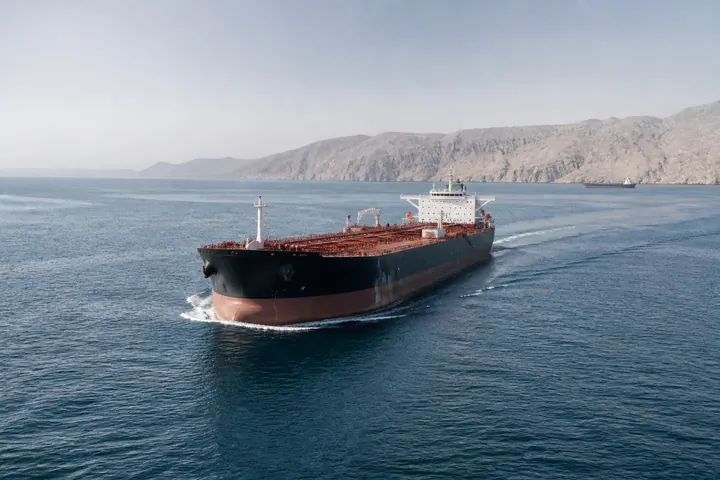 AI illustration
In a rush? Get the brief
- US Central Command said US forces carried out a new wave of strikes against IRGC military targets in Iran, including air-defence, radar, communications and maritime-related sites.
- US officials said the Tuesday strikes included attacks on two Iranian government tankers, whose engine rooms were hit by drone-launched missiles.
- Iran said it retaliated with missiles and drones directed at US-linked targets in Jordan, Bahrain, Kuwait and Iraqi Kurdistan.
- Jordan said it intercepted 10 of 13 Iranian ballistic missiles and that the remaining three landed in remote areas without reported casualties.
The key facts outlets agree on. Turn on Claims Mode to see who reported each claim, here or in the app. Get the app
In this story · 3 parts
US Central Command said a new wave of strikes targeted Islamic Revolutionary Guard Corps air-defence, radar, communications and maritime-related sites in Iran. US officials said drone-launched missiles also hit the engine rooms of two Iranian government tankers. Iran said it responded with missiles and drones against US-linked sites across the Middle East. Financial news reports said the exchange pushed oil prices higher, renewing concern over oil supplies and safe passage through the Strait of Hormuz.
Iran's military said its retaliation targeted US-linked sites in Jordan, Bahrain, Kuwait and Iraqi Kurdistan. Jordan's armed forces said they intercepted 10 of 13 Iranian ballistic missiles, while the remaining three landed in remote areas without reported casualties.
US embassies in Jerusalem, Jordan and Qatar urged Americans in the Middle East to exercise caution and heightened vigilance. They warned that tensions could bring flight cancellations, airspace closures and wider travel disruption, and that Iran or Iran-aligned groups might target additional US interests overseas.
Iranian officials and the Iranian Red Crescent alleged that a US strike hit a home hosting a wedding, but their reports differed on whether it was in Kuhestak or Sirik. The Red Crescent reported four deaths and more than 50 injuries. Hormozgan Province officials gave a higher toll of five deaths, including a child, and at least 68 injuries. Esmaeil Baghaei described the reported incident as a possible war crime requiring investigation.
“The U.S. military never targets civilians, unlike the IRGC.”
CENTCOM rejected the allegation that the US deliberately targets civilians and accused the IRGC of doing so instead. The competing accounts of the reported strike remain unresolved.
Strait of Hormuz: separate incidents and competing claims
- US officials said the new strikes included drone-launched missile attacks on the engine rooms of two Iranian government tankers.
- The Islamic Revolutionary Guard Corps said two oil tankers struck naval mines in the Strait of Hormuz and were disabled.
- In a separate assertion, Iran said a supertanker struck two mines in the strait. CENTCOM denied that supertanker mine claim.
- Saudi Arabia's national shipping company, Bahri, said two Filipino seafarers were killed in an incident involving its tanker Sidr in the Strait of Hormuz.
- The UK Maritime Trade Operations Centre received a report that a tanker was hit by three projectiles while exiting the Persian Gulf through the strait.
The tanker claims, the Sidr incident and the projectile report have not been established as a single event. CENTCOM said the earlier Larak Island operation struck two Iranian launchers after US forces observed preparations to fire rockets carrying sea mines into the Strait of Hormuz. It described those preparations as an imminent maritime threat. It described the operation as a defensive measure to protect civilian mariners, commercial shipping, personnel and trade from Iranian attacks and mine-laying preparations.
An unnamed US official said the strikes had temporarily lowered the threat to commercial shipping, buying at least a month of reduced danger. The Independent's analysis warned that further attacks on shipping or energy infrastructure could increase market anxiety and crude prices.
The Pentagon said 18 US service members had been killed and more than 750 wounded during the wider conflict. The toll covers the broader war rather than the new wave of strikes alone.
Washington and Tehran set out opposing political paths
Donald Trump said the United States was in a stronger position than Iran and did not need what he called a worthless deal, citing what he said was almost total US control of the Strait of Hormuz and Iran's collapsing economy. He threatened a much harder US strike if Iran retaliated again, saying it could leave very little of the Islamic Republic. Iranian President Masoud Pezeshkian, by contrast, said a negotiated end to the war remained preferable to continued fighting. He said Iran would immediately reciprocate if the United States restored what he described as its commitments set out in a June memorandum.
Treasury Secretary Scott Bessent said sanctions were intended to create conditions for negotiations rather than necessarily force Iran's economic collapse. He also predicted that Iran's economy could collapse within weeks or months under the new sanctions.
Iran's Armed Forces General Staff called the US attacks aggression, said they would strengthen Iran's resolve over Hormuz and warned of dangerous consequences for US partners. Barbara Leaf, a former US official, said Iran was likely to maintain sporadic attacks. Unnamed analysts said such attacks could create an escalatory spiral back into what they described as open air war, citing continuing US economic pressure and Iranian efforts to contest maritime traffic.
The Independent reported that unnamed White House officials were considering a larger increase in military operations after the November midterm election. The report said containing the conflict until the vote could limit the political harm of an unpopular war and allow time to replenish ammunition.
The £70.4bn ($95.2 billion) estimate represents an aggregate reduction in UK households' real disposable incomes. Higher energy costs linked to the conflict are central to the Centre for Economics and Business Research assessment of household spending power and UK growth. The consultancy estimated that the Iran war would leave the average UK household £2,400 ($3,246) worse off by the end of 2027. Liam Daly said the shock would reach households directly through energy costs and indirectly through monetary policy and the labour market. CEBR said higher energy costs and unchanged borrowing costs would reduce spending power and hurt UK growth.
Sources
34 reports from 18 outletsFrom New York Times, The Independent, The Guardian and 15 more
New York Times5
- U.S. and Iran Exchange Strikes Overnight After Monthlong Calm (opens in a new tab)
- U.S. Strikes Iran Over Strait of Hormuz Mines, Trump Says (opens in a new tab)
- U.S. and Iran Survey the Damage After a Night of Intense Strikes (opens in a new tab)
- Global Oil Price Rises to $90 a Barrel After U.S. and Iran Trade Attacks (opens in a new tab)
- The Navy’s Logistical Nightmare in the Iran War (opens in a new tab)
The Independent5
- Trump has no interest in ‘worthless’ deal with Iran as both sides launch new strikes (opens in a new tab)
- Iran-US war latest: Iranian hackers targeted critical US infrastructure in cyberattacks, say officials (opens in a new tab)
- Panicking Trump aides trying to pause unpopular Iran war to save GOP from midterm election disaster: report (opens in a new tab)
- Trump considering new strikes to stop Strait of Hormuz attacks as president threatens to ‘smack’ Tehran (opens in a new tab)
- Iran's president says Iran would return to ceasefire agreement if US does, and other Mideast news (opens in a new tab)
The Guardian4
- US and Iran exchange more airstrikes, fuelling fears of wider return to hostilities (opens in a new tab)
- Trump says US will ‘hit Iran hard’ as hostilities resume – as it happened (opens in a new tab)
- UK households will take £2,400 financial hit from Iran war, analysis shows (opens in a new tab)
- Iran attacks American bases in Middle East as it accuses US of ‘war crime’ over wedding strike – Middle East crisis live (opens in a new tab)
Axios3
Bloomberg2
NPR2
TheJournal.ie2
Al Jazeera
CBS News
CNBC
Daily Mail
Financial Times
Fox News
NBC News
Swindon Advertiser
The Hill
The New Yorker
Washington Post
How this story was made. Drafted with AI from 34 reports by 18 outlets. Each highlighted line in Claims Mode links to the reporting behind it. Debate level shows how sharply the positions reported in a story conflict. Source tone shows how much of our account rests on checkable facts and on-record quotes rather than interpretation. Both are scored by our model from our account of the coverage, out of 100, as in the app. How we make stories · Corrections · Spotted an error? Tell us
Similar stories
Trump Rejects Iran’s Hormuz Reopening Proposal
Donald Trump rejected Iran’s offer to reopen the Strait of Hormuz in exchange for lifting a US naval blockade, removing oil sanctions and restoring a regional ceasefire. Iran says it remains willing to negotiate through mediators, while US officials and allied voices argue that Tehran’s conditions are unacceptable. The dispute has left energy markets strained, exposed sharply different views on sanctions and military pressure, and kept Qatar-led indirect diplomacy alive but uncertain.
Riyadh Airport Attack Kills 12, Halts Flights
Saudi authorities report 12 deaths at Riyadh airport; Trump says the US may join action against the Houthis.

Trump’s Iran Remarks Prompt California Threat Monitoring
Newsom ordered threat monitoring after Trump named California cities; the White House and fact-checkers disputed critics’ interpretation.