U.S. Orders Non-Emergency Staff to Leave Saudi Arabia
Washington ordered non-emergency staff and eligible family members out of Saudi Arabia, citing Houthi attacks on airports and infrastructure.
- Debate level · 32 / 100 weak consensus
- Source tone · 84 / 100
Debate level shows how sharply the positions reported in a story conflict. Source tone shows how much of our account rests on checkable facts and on-record quotes rather than interpretation. Both are scored by our model from our account of the coverage, out of 100, as in the app.
Based on reports up to .
New here? Turn on Claims Mode to see where each claim comes from.
Claims Mode is on. Select any highlighted passage to see the reporting behind it.
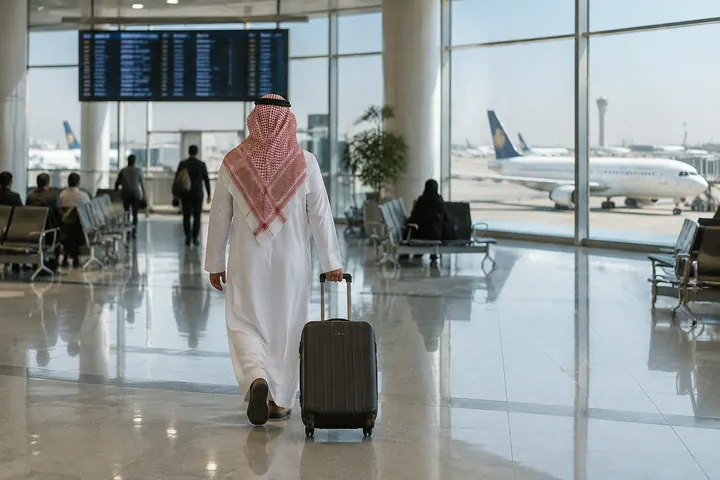 AI illustration
In a rush? Get the brief
- The United States ordered non-emergency government staff and eligible family members to leave Saudi Arabia as Houthi attacks on airports, oil facilities and other infrastructure caused deaths, injuries and flight disruptions.
- The dispute centers on the scale of the U.S. pullback and how to respond to the Houthi threat: the State Department says the departure order applies only to Saudi Arabia, while officials say other Gulf missions may move families; Trump is considering direct U.S. strikes.
- Travel to and within Saudi Arabia may face further restrictions, diversions and cancellations, while an escalation could threaten regional security and shipping near the Bab al-Mandab Strait.
- U.S. and Gulf missions are likely to further adjust staffing and security as attacks continue; Washington may decide soon whether to conduct strikes against the Houthis.
The key facts, in one minute. Turn on Claims Mode to see who reported each claim, here or in the app. Get the app
In this story · 3 parts
The U.S. State Department has ordered non-emergency government employees and eligible family members to leave Saudi Arabia, citing increasing Houthi attacks on civilian airports and other critical infrastructure. The department said the attacks had caused civilian casualties and severe travel disruption.
The Houthis have been attacking Saudi Arabia’s aviation and energy sectors for weeks. CBS News reported that a Houthi strike on Riyadh’s King Khalid International Airport killed 12 people, while Fox News reported at least 13 deaths. Both reported more than 300 injured.
State Department spokesperson Tommy Pigott said the department had "issued an ordered departure for non-emergency U.S. government employees and their family members in Saudi Arabia only" and called reports of a broader ordered withdrawal inaccurate. Four unnamed U.S. officials told Reuters that other Gulf missions would order family members to leave.
Other U.S. embassies in Gulf countries have adjusted or will adjust staffing under restricted operations, without receiving the Saudi-style departure order, according to the State Department. Restricted-operations status allows embassies to reduce staffing and services without fully suspending operations. U.S. officials separately told CBS News and NBC News that the military had been reducing its regional footprint because of threats from the Houthis and Iran.
Airports and oil facilities targeted
The Houthis acknowledged attacking Riyadh airport, according to The Seattle Times. The movement alleged, without evidence, that Saudi Arabia used the facility to transfer equipment to government forces.
Saudi Arabia’s civil aviation authority reported that an attack on King Fahd International Airport in Dammam killed one person and injured eight others. The airport also suffered material damage, according to The Guardian.
The airport attacks forced restrictions, diversions and cancellations on flights to Riyadh and Dammam, according to The Guardian and The Seattle Times. The U.S. Embassy in Riyadh warned that the Houthis could carry out further attacks on Saudi Arabia.
Saudi Arabia’s Energy Ministry said falling debris from an intercepted drone targeting the Shaybah oil field killed two people and injured two others. The Saudi-led coalition also reported intercepting multiple Houthi drones. Neither attack was immediately claimed by the Houthis.
The State Department described the Houthis as Iranian-supported. Some Saudi officials accused Iran of responsibility for the group’s conduct during the escalation, CBS News reported. Iran denied having any role in the escalation.
The cost of defence
Farea Al-Muslimi argued that Saudi Arabia’s vast territory makes it difficult to defend, even with sophisticated and expensive forces. Relatively inexpensive Houthi missiles and drones can impose disproportionate costs, he said: a large country needs costly defences across a wide area, leaving it vulnerable to a much smaller nonstate actor.
Additional missile interceptors are exceptionally scarce, Marco Rubio argued. He said demand was extraordinary worldwide and that Washington had to balance requests from allies against the weapons needed to meet its own military requirements.
The United States continues to provide Saudi Arabia with intelligence and targeting support, Fox News reported. Britain has announced it will deploy Typhoon fighter jets to help defend Saudi cities and critical infrastructure.
The State Department warned that hostilities could escalate rapidly beyond Saudi Arabia. CBS News identified a potential consequence for shipping: the Houthis’ proximity to the Bab al-Mandab Strait, a key oil-shipping chokepoint, creates a risk that escalation could affect areas beyond the kingdom.
Yemeni Foreign Ministry adviser Marwan Ali Noman argued that the Houthis could keep attacking unless confronted. He said the threat would expand and that the Yemeni government was seeking international assistance, CBS News reported.
President Donald Trump has left open the possibility of direct U.S. strikes on the Houthis. He said the option was under consideration and that a decision would be made quickly, according to reporting by CBS News and Fox News.
Sources
14 reports from 12 outletsFrom Bloomberg, The Hill, Al Jazeera and 9 more
Bloomberg2
The Hill2
Al Jazeera
CBS News
CNBC
Fox News
New York Times
Reuters
The Guardian
The Independent
The Seattle Times
The Times
How this story was made. Drafted with AI from 14 reports by 12 outlets. Each highlighted line in Claims Mode links to the reporting behind it. Debate level shows how sharply the positions reported in a story conflict. Source tone shows how much of our account rests on checkable facts and on-record quotes rather than interpretation. Both are scored by our model from our account of the coverage, out of 100, as in the app. How we make stories · Corrections · Spotted an error? Tell us
Similar stories
Riyadh Airport Attack Kills 12, Halts Flights
Saudi authorities report 12 deaths at Riyadh airport; Trump says the US may join action against the Houthis.

US and Iran Resume Military Strikes
A renewed US-Iran military exchange has brought regional missile retaliation, disputed civilian-casualty and maritime claims, shipping insecurity, competing diplomatic strategies and forecasts of significant economic consequences for UK households.
Hormuz attacks sink ships and disrupt trade
GFS Pride sank after a Hormuz attack as escalating strikes reduced oil shipments and widened risks for commercial shipping.