Justice Department seeks conditional block on Alaska Senate certification
The Justice Department seeks a conditional Alaska Senate certification block, alleging voter confusion; challengers dispute its authority.
- Debate level · 72 / 100 contentious
- Source tone · 88 / 100
Debate level shows how sharply the positions reported in a story conflict. Source tone shows how much of our account rests on checkable facts and on-record quotes rather than interpretation. Both are scored by our model from our account of the coverage, out of 100, as in the app.
Based on reports up to .
New here? Turn on Claims Mode to see where each claim comes from.
Claims Mode is on. Select any highlighted passage to see the reporting behind it.
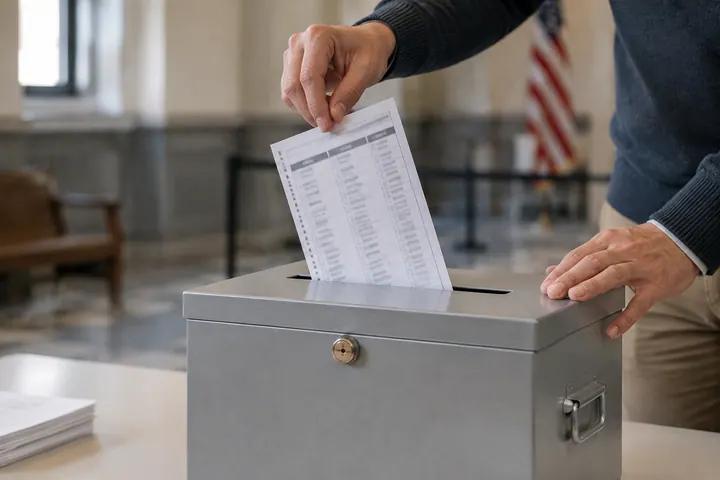 AI illustration
In a rush? Get the brief
- The Justice Department sued to conditionally block certification of Alaska’s Senate result if Sen. Dan Sullivan loses and a ranked-choice recalculation treating votes for Daniel J. Sullivan Jr. as votes for the incumbent would make Sullivan the winner.
- The dispute is over whether the similarly named candidate is misleading voters and whether DOJ has legal authority to delay state certification; Trump said he directed the lawsuit, while Peltola, voting-rights groups and election-law experts call it improper and legally weak.
- A court-ordered block could delay certification and affect a close race that may help determine Senate control, though the lawsuit itself does not halt voting or invalidate ballots.
- Alaska voting-rights groups and voters will seek dismissal, and a federal court will decide whether DOJ can obtain relief; experts cited expect the case to fail or be short-lived.
The key facts, in one minute. Turn on Claims Mode to see who reported each claim, here or in the app. Get the app
The Justice Department has asked a federal court to block certification of Alaska’s Senate result if incumbent Republican Sen. Dan Sullivan loses. The requested order would apply only if treating all votes cast for candidate Daniel J. Sullivan Jr. as votes for Sen. Sullivan, followed by ranked-choice tabulation, would produce a victory for the senator. It alleges that another candidate with a similar name is trying to mislead Sullivan’s supporters and benefit rival Mary Peltola. The department seeks the block pending an investigation into whether votes for Sullivan Jr. were intended for the senator. The complaint also requests any further procedures or relief the court considers necessary to determine the result without Sullivan Jr. on the ballot.
President Donald Trump said: “I'm the one that said do it.” Peltola’s campaign and Democratic critics call it a corrupt political attempt to overturn an election and retain power, pointing to Trump’s involvement and the effort to halt certification if the Republican incumbent loses.
Alaska courts have allowed Daniel J. Sullivan Jr. to remain on the ballot, with the state Supreme Court ruling in June. The ballot identifies the senator as “Sullivan, Dan S (Registered Republican) Incumbent”; the other candidate appears as “Sullivan, Daniel J Jr” with no party affiliation.
Sen. Lisa Murkowski argues that those ballot distinctions make the lawsuit unnecessary and that Alaskans can identify and vote for their preferred candidate without Justice Department intervention. Political scientist Glenn Wright said voters should have no problem recognising the two candidates and described the ballot as very clear about which Dan Sullivan is the incumbent. Political scientist Forrest Nabors said similar candidate names could swing a close election if voters intending to re-elect the senator mistakenly vote for the other Sullivan.
The department’s argument centers on the possibility that voters seeking Sen. Sullivan will mistakenly choose the other candidate. It contends that votes diverted from the incumbent, or transferred to Peltola under Alaska’s ranked-choice voting system, could change the outcome of a close race. Under that system, voters rank candidates in order of preference rather than voting for only one candidate; if no candidate receives more than 50 percent of first-choice votes, the candidate with the fewest votes is eliminated and those votes are transferred to next-ranked candidates who remain in the race.
Trump and Republican allies portray Sullivan Jr. as a Democratic-backed spoiler intended to divert votes from the senator. Sullivan Jr. denies that his campaign is a sham or coordinated with Democrats. He says he is dissatisfied with the incumbent’s record and entered the race to offer voters a legitimate choice.
Peltola received 49.5% of the vote in the August primary, compared with about 41% for Sen. Sullivan and 2.5% for Sullivan Jr. Published polling cited by the BBC and Newsweek has shown either a slight Peltola lead or a near-even contest ahead of November. Political observers say the result could affect control of the U.S. Senate.
Attorney General Todd Blanche said: “It’s never our intention, to improperly interfere with elections or the state confirmation process or certification process,” while declining to rule out intervention in hypothetical circumstances.
Democrats, voting-rights advocates and civil-rights groups fear similar certification challenges in other races where Republicans lose. They cite that refusal, the administration’s broader election-related litigation and the Alaska suit’s pre-election challenge to certification.
The limits of federal authority
The legal dispute turns in part on the reach of the National Voter Registration Act. Election-law experts including Derek Muller say that statute does not empower the Justice Department to challenge which candidates appear on Alaska’s ballot or obtain an order delaying certification of the result.
The department’s complaint relies on the act’s stated purpose of protecting “the integrity of the electoral process” and a provision allowing the attorney general to seek court orders to enforce the act. In their request to join the case, the voting-rights groups and voters argue that the department’s legal claim rests on language in the law’s findings and purposes.
They also question how anonymous ballots could establish whether votes for Sullivan Jr. were actually intended for the incumbent. Muller and other experts expect the case to fail or survive only briefly.
The League of Women Voters of Alaska, Common Cause and two Alaska voters have moved to dismiss the case. The organizations argue that the suit disrupts the constitutional division under which states administer elections unless Congress expressly authorizes federal intervention.
The groups say the department is asserting nearly unlimited power over a process run by state and local officials, without authority under the cited statute. If the court grants the requested relief, they warn, certification could be delayed and Alaska voters could be disenfranchised.
Filing the lawsuit does not itself stop Alaska’s election or invalidate ballots. A court would have to grant relief for the department’s requested certification block to take effect.
Sources
19 reports from 15 outletsFrom Daily Mail, New York Times, CBS News and 12 more
CBS News2
Daily Mail2
New York Times2
The Independent2
Al Jazeera
Axios
BBC
Bloomberg
CNBC
Mother Jones
NBC News
Newsweek
Roll Call
The Hill
Vox
How this story was made. Drafted with AI from 19 reports by 15 outlets. Each highlighted line in Claims Mode links to the reporting behind it. Debate level shows how sharply the positions reported in a story conflict. Source tone shows how much of our account rests on checkable facts and on-record quotes rather than interpretation. Both are scored by our model from our account of the coverage, out of 100, as in the app. How we make stories · Corrections · Spotted an error? Tell us
Similar stories
Justice Department sues California over voter citizenship
The Justice Department seeks to withhold flagged California mail ballots pending citizenship checks; state officials challenge its evidence.
Smith Defends Trump Cases Before Senate
Jack Smith defended his Trump prosecutions as Republicans challenged his methods and accused him of misleading Congress.

Suspicious mail targets election offices and lawmakers
Federal investigators examine nationwide mailings as preliminary tests find no hazardous material and offices face evacuations.