Smith Defends Trump Cases Amid Republican Perjury Allegations
Jack Smith defended his Trump prosecutions as Republicans challenged his methods and accused him of misleading Congress.
- Debate level · 78 / 100 contentious
- Source tone · 82 / 100
Debate level shows how sharply the positions reported in a story conflict. Source tone shows how much of our account rests on checkable facts and on-record quotes rather than interpretation. Both are scored by our model from our account of the coverage, out of 100, as in the app.
Based on reports up to .
New here? Turn on Claims Mode to see where each claim comes from.
Claims Mode is on. Select any highlighted passage to see the reporting behind it.
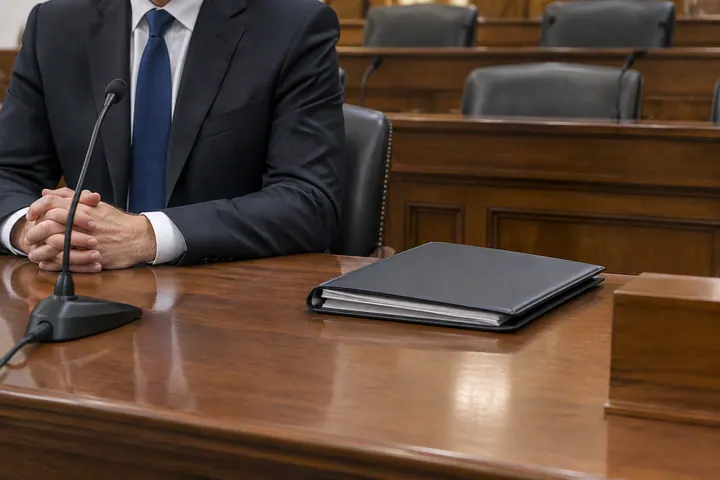 AI illustration
In a rush? Get the brief
- Jack Smith testified before the Senate Judiciary Committee and defended his decision to bring criminal charges against Donald Trump.
- Smith led two federal Trump prosecutions: one involving alleged efforts to overturn the 2020 election and another involving classified documents and alleged obstruction.
- The federal cases against Trump did not reach trial and were dismissed after his 2024 reelection because of Justice Department policy against prosecuting a sitting president.
- The phone toll records sought by Smith's office showed call metadata, such as numbers, times and duration, rather than call or message content.
The key facts outlets agree on. Turn on Claims Mode to see who reported each claim, here or in the app. Get the app
In this story · 3 parts
Jack Smith defended his decision to prosecute Donald Trump before the Senate Judiciary Committee, saying the cases rested on evidence rather than politics. Republican senators accused the former special counsel of abusing his authority to target their party.
A separate false-statement dispute concerned Smith's earlier House testimony about lawmakers' records. Toll records contained metadata, such as phone numbers, times and durations, while text-message contents were obtained separately through a subpoena. The disagreement centered on whether Smith's answers addressed only toll records or gave a broader impression about access to message contents.
“I stand by my decisions as special counsel, including my decision to bring charges against President Trump.”
Smith said his charging decisions took no account of Trump's political affiliation, beliefs or 2024 candidacy. He maintained that investigators had developed proof beyond a reasonable doubt of serious crimes and said he would have made the same decision regardless of a former president's party.
The two federal prosecutions concerned alleged efforts to overturn the 2020 election and the handling of classified documents and alleged obstruction. Neither reached trial. The election-related case was dismissed after Trump's 2024 reelection because of Justice Department policy against prosecuting a sitting president; the classified-documents case was dismissed separately.
The dispute over lawmakers' records
The toll records sought by Smith's office contained metadata—phone numbers, times and durations—but not the content of calls or messages. Smith said the toll records were relevant to understanding the scope of the conspiracy under investigation and the people conspirators were seeking to coerce, influence or enlist.
Smith testified in December during a closed-door deposition before the House Judiciary Committee. During that deposition, he told the committee that he had not sought a search warrant for the content of lawmakers' text messages, only toll records.
Separately, Smith's office obtained text-message contents involving 44 lawmakers through a subpoena to the National Archives and Records Administration.
After Smith's December deposition and the separate subpoena, House Judiciary Chairman Jim Jordan referred Smith to the Justice Department, alleging false or misleading statements about records obtained in the Trump investigation. The referral raised the possibility that Smith could face a Justice Department prosecution over allegations that he made false statements to Congress. Jordan and other Republican critics argued that Smith's answers gave the misleading impression that neither he nor his team had access to lawmakers' privileged text messages.
Smith's lawyers, Peter Koski and Lanny Breuer, described the referral as an attempt to weaponize the justice system against a nonpartisan public servant and said his answers were truthful. They said the questions at issue explicitly concerned toll records, not separately obtained messages, and the toll records did not contain message content. Former federal prosecutors told NBC News that such a case would be difficult.
Chuck Grassley's criticism concerned the investigation's broader reach. He argued that it went beyond Trump to map the Republican political apparatus, citing records involving lawmakers and Republican organizations as evidence of political targeting and an abuse of authority.
Smith said his team consulted the Justice Department's Public Integrity Section before obtaining lawmakers' records. He said he sought gag orders accompanying congressional-record subpoenas to guard against possible interference with the investigation by preventing disclosure that could enable it.
Democrats Dick Durbin and Cory Booker argued that the attacks diverted attention from Trump's alleged unlawful conduct. Durbin cited Trump's alleged disregard for the law, voters' will and national security, while Booker accused Republicans of perpetuating the false claim that Trump was cheated in the 2020 election.
Limits on Smith's testimony
Smith's defense at the hearing concerned charging decisions in both federal cases. U.S. District Judge Aileen Cannon blocked release of the classified-documents portion of his final report. The Justice Department said that answering questions about the investigation would violate the order; under that interpretation, this limited what Smith was expected to discuss about the classified-documents investigation, rather than the election-related case.
In a separate accusation, Senator Eric Schmitt raised a challenge centered on a basketball game. Schmitt accused Smith of perjury over whether he had been in Atlanta in February 2024, citing what he believed were records of attendance at an Atlanta Hawks game. Schmitt said he was trying to establish the extent of any coordination with the Atlanta prosecutor.
But NBC News reported that the February 3, 2024 date cited by Schmitt concerned an Iowa Hawkeyes women's basketball game at Maryland, which Smith said he attended. Amy Klobuchar said the accusation confused the Hawks with the Hawkeyes and criticized Schmitt for accusing Smith of perjury and insulting him without first checking his facts. After NBC News reported on the date, Schmitt continued to say that a prosecutor should determine whether Smith had lied.
Following the records-related referral and the separate basketball-game accusation, Smith broadened his response beyond the factual disputes to what he described as threats to Justice Department norms and the rule of law. Smith argued that predetermined outcomes were displacing Justice Department norms and that political threats of prosecution against people seen as opposing the president threatened the rule of law. He cited the effects on his former team as part of that concern: Smith said members of his former team had lost jobs and had their lives disrupted because of what he described as illegal targeting.
Sources
22 reports from 13 outletsFrom NBC News, The Independent, Roll Call and 10 more
NBC News4
- Jack Smith testifies at Senate hearing, defending decision to charge Trump (opens in a new tab)
- GOP senator airballs perjury claim against Jack Smith over apparent Hawks/Hawkeyes mix-up (opens in a new tab)
- ‘A total dirtbag’: GOP senator mistakenly accuses Smith of perjury over NBA game (opens in a new tab)
- Senate GOP to press Jack Smith on Trump Jan. 6 probe as DOJ targets investigators (opens in a new tab)
The Independent4
- Republican fumbles Jack Smith conspiracy theory and calls Trump prosecutor ‘dirtbag’ in testy hearing (opens in a new tab)
- Senator reveals the moment she knew viral Jack Smith gotcha was a slow-mo train wreck (opens in a new tab)
- Viral slow zoom on Katie Britt says it all as she realizes Jack Smith gotcha moment is going up in flames (opens in a new tab)
- Senator behind viral Jack Smith gotcha blunder doubles down when confronted over error (opens in a new tab)
New York Times2
Roll Call2
The Bulwark2
ABC News
Al Jazeera
CBS News
Daily Mail
NPR
PBS NewsHour
The Hill
Washington Post
How this story was made. Drafted with AI from 22 reports by 13 outlets. Each highlighted line in Claims Mode links to the reporting behind it. Debate level shows how sharply the positions reported in a story conflict. Source tone shows how much of our account rests on checkable facts and on-record quotes rather than interpretation. Both are scored by our model from our account of the coverage, out of 100, as in the app. How we make stories · Corrections · Spotted an error? Tell us
More to read
Federal Agents Search Ilhan Omar’s Home
Federal agents searched Omar’s home weeks before the midterms; she accused the Trump administration of political targeting.
Government-Funded Trump Ads Face Propaganda Complaints
Government-funded Trump ads have prompted oversight complaints and Republican objections; the White House calls them public service announcements.
Justice Department sues California over voter citizenship
The Justice Department seeks to withhold flagged California mail ballots pending citizenship checks; state officials challenge its evidence.