Supreme Court weighs oil companies’ challenge to Boulder lawsuit
The justices heard competing arguments over whether federal law bars Boulder’s climate-damages claims against oil companies.
- Debate level · 72 / 100 contentious
- Source tone · 88 / 100
Debate level shows how sharply the positions reported in a story conflict. Source tone shows how much of our account rests on checkable facts and on-record quotes rather than interpretation. Both are scored by our model from our account of the coverage, out of 100, as in the app.
Based on reports up to .
New here? Turn on Claims Mode to see where each claim comes from.
Claims Mode is on. Select any highlighted passage to see the reporting behind it.
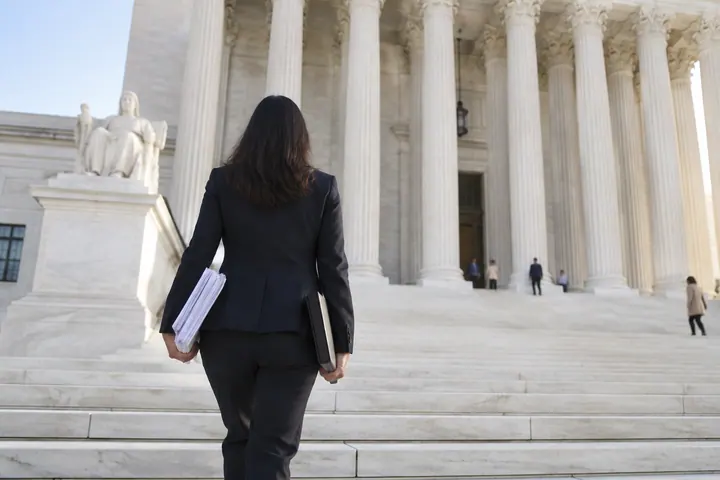 AI illustration
In a rush? Get the brief
- The Supreme Court heard ExxonMobil and Suncor’s challenge to Boulder County’s state-court lawsuit seeking climate-related costs over alleged deception about fossil-fuel harms.
- The dispute is whether federal law and the Clean Air Act preempt Boulder’s state-law damages claims, or whether the county may pursue a traditional local-injury and consumer-deception case.
- The ruling could determine whether Boulder and dozens of similar state and local climate-liability lawsuits can proceed, affecting potential corporate exposure for climate-related damages.
- The Court will issue a decision; it could block the claims, allow the case to continue, split 4-4 after Justice Alito’s recusal, or dismiss for lack of jurisdiction.
The key facts, in one minute. Turn on Claims Mode to see who reported each claim, here or in the app. Get the app
In this story · 4 parts
In Suncor Energy Inc. v. County Commissioners of Boulder County, the US Supreme Court heard arguments over ExxonMobil and Suncor’s effort to block Boulder County’s state-court lawsuit seeking compensation for climate-related costs. The case concerns Boulder County’s lawsuit, but the ruling on whether federal law bars state-law climate claims could affect similar climate-liability cases brought by states and local governments.
The central dispute is whether Boulder’s requested damages remedy can proceed under state law despite the companies’ federal-law objections. The Court is considering whether the claims are wholly precluded by federal law and must be dismissed, rather than whether Boulder can ultimately prove liability. Boulder County filed the lawsuit in 2018, alleging that the companies deceived the public about the climate harms of fossil fuels and seeking compensation for climate-related costs. The Colorado Supreme Court allowed the county’s state-law claims to proceed in a 5–2 ruling, finding that federal law did not bar them at that stage.
Boulder describes its case as a traditional state-law damages action over alleged deception and local injuries, rather than an attempt to regulate greenhouse-gas emissions. Its lawyer, Kevin Russell, says the county is seeking money for repairs, emergency services and property costs, not an injunction preventing fossil-fuel production and not a direct restriction on production. He argues that requiring the companies to bear part of the costs allegedly caused by their conduct is an application of state damages law.
Companies’ federal-law challenge
The companies argue that Boulder’s requested damages remedy cannot proceed under state law because, in their view, state-law claims over a global problem intrude on authority reserved for federal institutions. The companies characterize Boulder’s allegations as a global causal chain from fossil-fuel production and marketing, through consumers’ fuel use and emissions, to localized harms in Boulder. They ground their challenge in the Constitution and the Clean Air Act, which they contend reserve authority over interstate pollution to federal institutions; in their view, Boulder cannot use state law to reach global conduct simply by framing its demand as a local damages claim. The companies’ industry supporters predict that allowing the case to continue could spur widespread litigation and potentially ruinous liability. They also argue that damages claims would allow state and local juries to make conflicting energy policy.
The Trump administration supports the companies. It argues that interstate air pollution is inherently federal and that states cannot fill perceived gaps in federal regulation by applying their own laws. Allowing Boulder’s case, the administration says, would let Colorado impose its preferences on conduct and parties outside the state.
Justices’ questions and Boulder’s response
Justice Elena Kagan questioned why Boulder’s lawsuit should be treated differently from state litigation against tobacco and opioid companies. She compared the alleged misconduct and local harms, asking why those industry cases could proceed while climate-related state claims could not. Justice Brett Kavanaugh indicated that interstate air and water pollution are federal matters unless Congress authorizes a different approach. Invoking Supreme Court precedents and the Clean Air Act framework, he suggested that, rather than authorizing state claims, Congress may already have treated interstate pollution as a federal-law issue without passing a new, explicit prohibition on Boulder’s suit.
Russell argues that Congress remains free to expressly preempt these claims. Legal scholars and advocates supporting Boulder say Congress has not done so and that neither the Constitution nor the Clean Air Act clearly supplies the blanket bar the companies seek. They add that state tort law commonly addresses injuries inside a state caused by conduct outside it, and that the companies have not identified a statute, legal doctrine or constitutional text establishing the requested immunity from Boulder’s claims.
Whether the Court has jurisdiction
Several justices questioned whether Supreme Court review was premature, SCOTUSblog reported. Boulder’s case has not gone to trial or produced a final state-court judgment. The Court could dismiss on jurisdictional grounds by finding that it lacks jurisdiction at this stage, avoiding resolution of the federal-law dispute. Such a finding would leave the broader constitutional and Clean Air Act questions unresolved for now.
Justice Samuel Alito recused himself, leaving eight justices to hear the case. Each of the following outcomes would leave the Colorado Supreme Court’s ruling in place and allow the county’s lawsuit to proceed in state court:
- The Court divides 4–4.
- The Court sides with Boulder.
- The Court declines jurisdiction.
A decision declining jurisdiction, in particular, would leave the broader federal-law questions unresolved at this stage.
Sources
17 reports from 13 outletsFrom SCOTUSblog, New York Times, Reason and 10 more
LA Times2
New York Times2
Reason2
SCOTUSblog2
Ars Technica
Fox News
Grist
Houston Public Media
Inside Climate News
NPR
Roll Call
The Guardian
Vox
How this story was made. Drafted with AI from 17 reports by 13 outlets. Each highlighted line in Claims Mode links to the reporting behind it. Debate level shows how sharply the positions reported in a story conflict. Source tone shows how much of our account rests on checkable facts and on-record quotes rather than interpretation. Both are scored by our model from our account of the coverage, out of 100, as in the app. How we make stories · Corrections · Spotted an error? Tell us
Latest in Courts
Army Schedules Hasan’s Firing-Squad Execution
The Army set Hasan’s firing-squad execution for Dec. 3; a civilian court challenge could delay it.
Grenfell files reach prosecutors after nine-year investigation
Grenfell files reach prosecutors, with charging decisions promised before the fire’s tenth anniversary in June 2027.

Supreme Court Allows Third-Country Deportations to Resume
The Supreme Court allowed removals to resume while leaving the policy’s legality unresolved ahead of December arguments.