SpaceX and Tesla Explore Merger With Shareholder Hurdles Ahead
Musk says independent committees are exploring a merger, but no transaction terms have been agreed.
- Debate level · 24 / 100 weak consensus
- Source tone · 86 / 100
Debate level shows how sharply the positions reported in a story conflict. Source tone shows how much of our account rests on checkable facts and on-record quotes rather than interpretation. Both are scored by our model from our account of the coverage, out of 100, as in the app.
Based on reports up to .
New here? Turn on Claims Mode to see where each claim comes from.
Claims Mode is on. Select any highlighted passage to see the reporting behind it.
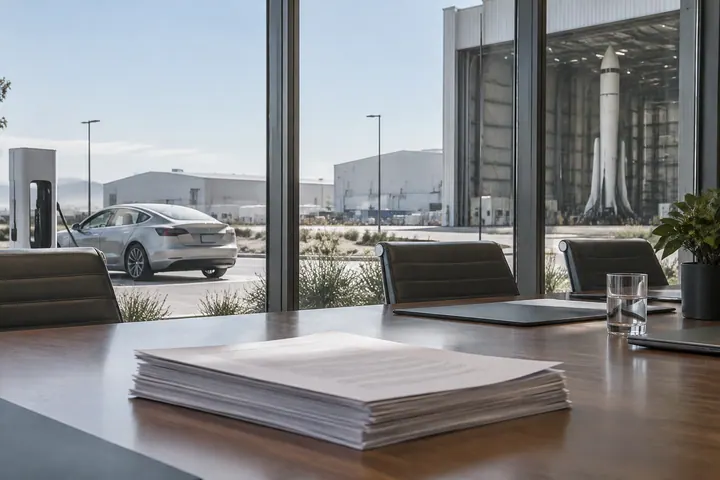 AI illustration
In a rush? Get the brief
- SpaceX and Tesla formed independent board committees to explore a possible merger, though no terms have been agreed; shares of both companies rose after the disclosure.
- The central issue is whether combining the Musk-led companies would create technology synergies in AI, chips, robotics and connectivity while fairly addressing conflicts of interest, valuation, ownership and shareholder dilution.
- Tesla investors could face a consequential vote requiring approval from 50% of all outstanding shares, and a Tesla-led deal could dilute their stakes or divert capital from vehicle and battery expansion.
- The committees are likely to continue evaluating structure and terms, potentially favoring a SpaceX-led transaction, before any proposal can go to Tesla shareholders; Musk says no deal is guaranteed.
The key facts, in one minute. Turn on Claims Mode to see who reported each claim, here or in the app. Get the app
In this story · 3 parts
SpaceX and Tesla have formed separate committees of independent directors to examine a possible merger, Elon Musk said.
The discussions remain exploratory: the committees have not agreed on transaction terms, Musk said. Fortune estimates that a combined company would have a market value of roughly $3.5 trillion (£2.62 trillion). Separately, Axios’s standalone estimates put SpaceX at roughly $2 trillion (£1.5 trillion) and Tesla at roughly $1.5 trillion (£1.12 trillion).
Shares in both companies rose in after-hours trading after Musk disclosed the discussions, according to the Los Angeles Times. Tesla stock rose just over 1% in after-hours trading, while SpaceX shares rose above 5%.
Technology rationale and deal structure
Musk supports a combination. He cites complementary work in superintelligence software, chip design, robotics, connectivity and related infrastructure, and says closer cooperation could offer gains.
Separately, Ars Technica’s analysis argues that a combined company would most probably prioritize AI and computing power over Mars settlement and mass-market cars.
The companies already have financial ties. NBC News, citing company disclosures, reported that Tesla announced in January that it was investing about $2 billion (£1.5 billion) to acquire shares in an AI startup that is a SpaceX subsidiary.
Tesla completed an approximately $2.00 billion (£1.5 billion) investment in SpaceX shares on March 12, 2026, according to its proxy. The proxy says SpaceX’s merger with xAI Holdings converted Tesla’s right to buy xAI Holdings shares into a right to buy SpaceX shares.
The potential transaction could take either a SpaceX-led or a Tesla-led form.
**SpaceX-led deal:** The Verge reported that most Wall Street analysts and legal experts consider SpaceX more likely to acquire or absorb Tesla than the reverse. They cited SpaceX’s higher valuation, saying a SpaceX-led acquisition or stock swap would leave SpaceX shareholders with majority control.
**Tesla-led deal:** If Tesla were to buy SpaceX, The Verge’s analysis identifies a financial risk for Tesla shareholders: their holdings could be diluted, while SpaceX’s spending needs could constrain Tesla’s ability to fund car factories and battery plants.
Tesla shareholder approval requirement
Musk said the special committees were established at shareholders’ request and that he is not participating in their merger discussions because he is a conflicted party. He also said he owns a roughly 20% stake in Tesla, owns a 45% stake in SpaceX, and wields control over about 82% of SpaceX’s voting power.
With transaction terms still unresolved, Musk said a deal could proceed on Tesla’s side only with approval from 50% of all shares—not merely 50% of the shares cast in a ballot. Tesla's annual shareholder proxy report does not include a merger proposal for shareholders to vote on.
Axios reported one analyst’s forecast from Gene Munster: he assigns a 95% chance to a transaction within two years, based on his expectation that shareholders would support it. Musk has cautioned that a deal may not be completed. The terms remain unresolved, and Musk said a Tesla-side deal would require shareholder approval.
Sources
16 reports from 15 outletsFrom BBC, Ars Technica, Axios and 12 more
BBC2
Ars Technica
Axios
Belfast Telegraph
Business Insider
Financial Times
Fortune
Gizmodo
LA Times
MarketWatch
NBC News
TechCrunch
The Economist
The Seattle Times
The Verge
How this story was made. Drafted with AI from 16 reports by 15 outlets. Each highlighted line in Claims Mode links to the reporting behind it. Debate level shows how sharply the positions reported in a story conflict. Source tone shows how much of our account rests on checkable facts and on-record quotes rather than interpretation. Both are scored by our model from our account of the coverage, out of 100, as in the app. How we make stories · Corrections · Spotted an error? Tell us
More to read
Musk Pledges SpaceX Shares for U.S. Children
Musk promises children SpaceX shares through Trump Accounts, but eligibility rules and sale restrictions shape the proposed gift.
Meta’s New Shares Preserve Zuckerberg’s Voting Control
Meta approved non-voting shares as Zuckerberg pledged eight years of residency in California or wherever it is headquartered, conditional on continued full-time leadership and an unforeseen-circumstances exception.