New York Council Approves Horse-Carriage Phaseout by June 2028
New York's council approved a carriage phaseout by 2028, drawing a promised court challenge from the drivers' union.
- Debate level · 72 / 100 contentious
- Source tone · 86 / 100
Debate level shows how sharply the positions reported in a story conflict. Source tone shows how much of our account rests on checkable facts and on-record quotes rather than interpretation. Both are scored by our model from our account of the coverage, out of 100, as in the app.
Based on reports up to .
New here? Turn on Claims Mode to see where each claim comes from.
Claims Mode is on. Select any highlighted passage to see the reporting behind it.
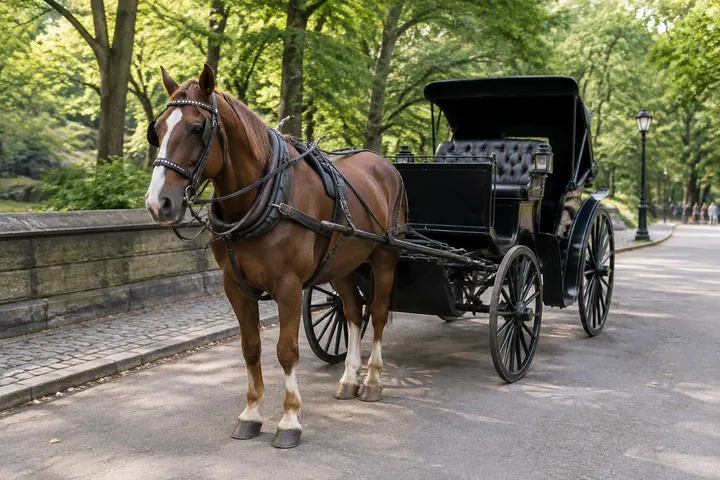 AI illustration
In a rush? Get the brief
- New York City Council voted 40–7 to phase out horse-drawn carriages by June 1, 2028; the bill now goes to Mayor Zohran Mamdani.
- Supporters cite safety, horse welfare and a fatal Central Park carriage incident, while drivers and opponents argue the industry is regulated, culturally valuable and essential to workers' livelihoods.
- Central Park visitors could lose horse-carriage rides by 2028, while more than 150 drivers, owners and horses face an uncertain transition despite planned job assistance and anti-slaughter protections.
- Mamdani is expected to consider and likely sign the bill; the Transport Workers Union plans a federal lawsuit and seeks to halt the ban.
The key facts, in one minute. Turn on Claims Mode to see who reported each claim, here or in the app. Get the app
The New York City Council voted 40–7, with two abstentions, to phase out horse-drawn carriages by June 1, 2028. The measure would stop new horse-drawn-cab licenses and end a Central Park tourist tradition spanning more than 160 years. Licenses active as of the effective date of the bill would permanently expire on May 31, 2028, without further renewal requirements.
Romanch's Law now goes to Mayor Zohran Mamdani, who has supported ending the industry. It is named for Romanch Mahajan, an 18-year-old tourist from India who died in June after a horse-drawn carriage incident in Central Park. His death prompted the council's action.
The Transport Workers Union says it will challenge the ban in federal court and seek a temporary restraining order. Drivers and owners warn that the phaseout could cost them their livelihoods.
The Central Park Conservancy said Mahajan's death "was the ninth carriage-related incident in just over a year", but its June 17, 2026 statement counted "eight horse-related incidents in Central Park over the past thirteen months". The counts differ, and whether they cover the same events has not been confirmed. The conservancy and Council Speaker Julie Menin argue that carriages are unsafe and unsustainable for both people and horses, citing repeated incidents, the pressures of operating among roughly 42 million annual park visitors, and horses pulling heavy loads in record heat.
Driver Alexus Lawson disputes mistreatment claims, saying the horses are cared for, enjoy the stimulation of their work and operate in a highly regulated industry. Lawson also questions the safety rationale: if safety were the real concern, an immediate ban—not a two-year phaseout—would be expected.
Other carriage drivers have expressed sorrow over Mahajan's death while arguing that a single fatal incident does not justify dismantling an entire industry. President Donald Trump also opposes the ban, comparing it to banning cars after crashes. He argues that the city does not stop vehicles entering the park despite many accidents.
Councilwoman Vickie Paladino favors regulation rather than elimination. She argues that the industry supports immigrant and small-business operators whose livelihoods are rooted in the city, and attracts visitors from around the world.
The transition for horses and workers
The legislation would bar the sale or transfer of carriage horses for slaughter and allow owners to keep their horses. The American Society for the Prevention of Cruelty to Animals supports the ban, arguing that city streets are inherently unsafe and harmful for carriage horses, while the phaseout and workforce protections offer a responsible alternative to temporary reforms.
Carriage driver Christina Hansen says the city has not made clear how horses would be relocated and warns that uncertain funding could complicate their future care. She argues that PETA's $50,000 (£37,384) pledge is inadequate for long-term care, and predicts that most carriage horses could end up dead or missing after the stable system closes.
For workers, the bill requires a transition plan, though reports differ on whether compensation is guaranteed. The mayor would have to establish the plan by April next year, including career counseling, training and employment referrals. Potential employers could include the Port Authority, the Metropolitan Transportation Authority and private tourism and transportation operators. Menin says it is intended to support more than 150 active carriage drivers. The bill requires officials to consider compensation for carriage-horse owners and for cab owners' businesses, licenses and equipment, rather than requiring those payments.
Drivers and owners warn of business losses, possible stable closures and carriage medallions becoming worthless. The union says the legislation lacks a concrete financial plan and does not specify how those losses would be addressed. Union officials describe it as a plan to create another plan, rather than concrete relief.
The union also argues that the bill unconstitutionally takes property without due process. Its lawyer, Arthur Schwartz, says government may regulate businesses or prevent abuses but cannot take property for a reason unrelated to public welfare. The drivers' proposed federal complaint would allege violations of the Fifth Amendment and the New York state constitution.
A New York City Law Department spokesperson said the department was confident the legislation was grounded in law and would defend it.
Sources
15 reports from 10 outletsFrom New York Times, Bloomberg, Fox News and 7 more
New York Times3
BBC2
Bloomberg2
Fox News2
ABC News
Courthouse News Service
Forbes
Gothamist
Newsweek
The Independent
How this story was made. Drafted with AI from 15 reports by 10 outlets. Each highlighted line in Claims Mode links to the reporting behind it. Debate level shows how sharply the positions reported in a story conflict. Source tone shows how much of our account rests on checkable facts and on-record quotes rather than interpretation. Both are scored by our model from our account of the coverage, out of 100, as in the app. How we make stories · Corrections · Spotted an error? Tell us