iPhone Duo launches with sellouts and months-long waits
Apple’s first foldable reached stores with sellouts, as limited supply left some buyers facing months-long waits.
- Debate level · 34 / 100 weak consensus
- Source tone · 78 / 100
Debate level shows how sharply the positions reported in a story conflict. Source tone shows how much of our account rests on checkable facts and on-record quotes rather than interpretation. Both are scored by our model from our account of the coverage, out of 100, as in the app.
Based on reports up to .
New here? Turn on Claims Mode to see where each claim comes from.
Claims Mode is on. Select any highlighted passage to see the reporting behind it.
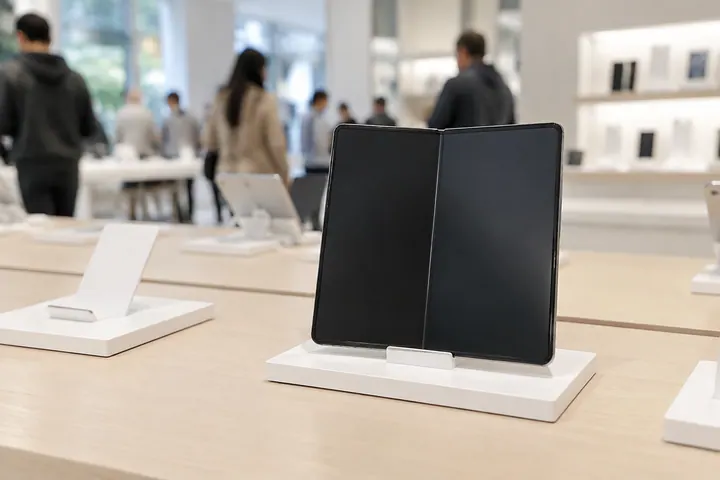 AI illustration
In a rush? Get the brief
- Apple’s first foldable, the iPhone Duo, launched Oct. 23 with long queues, rapid sellouts and delivery estimates stretching as far as late January 2027.
- The central question is whether Apple’s $1,999-and-up foldable can turn strong early demand into significant market share and revenue despite constrained supply, a niche market and concerns that high prices could slow upgrades.
- Prospective buyers may face limited store availability and lengthy waits, while weighing the Duo’s large foldable display, multitasking and Apple Pencil features against its premium price.
- Apple is likely to continue managing constrained supply; some direct Apple preorder customers may receive earlier delivery dates as inventory allocations shift.
The key facts, in one minute. Turn on Claims Mode to see who reported each claim, here or in the app. Get the app
In this story · 3 parts
Apple’s first foldable phone, the iPhone Duo, went on sale on Oct. 23 amid queues and rapid store sellouts. Prices start at $1,999 (£1,495) in the US and £1,999 ($2,674) in the UK, rising to $3,199 (£2,392) or £3,199 ($4,279) for the 2TB model.
Apple said preorder demand was "nothing short of extraordinary." Tarun Pathak expected initial demand to exceed supply, citing Apple’s roughly 1.4 billion installed iPhone base and Counterpoint’s expectation of roughly 6 million or fewer units available in the near term. Even a small share of early adopters could overwhelm that stock, he argued, according to CNBC. IDC expects initial iPhone Duo supply to be constrained because of the device’s complexity and Apple’s manufacturing and quality standards.
In Huntington, New York, customers still in line were dismissed after the store announced it had sold out before opening, CNET reported. In Seattle, about 180 people without preorders waited at Apple’s University Village store, which sold out within 15 minutes of opening.
Preorders opened on Oct. 16, with launch-day pickup inventory selling out and some online delivery estimates quickly slipping into late January 2027. Some early customers received November or December estimates, the Daily Mail reported.
One customer quoted by the Daily Mail said Apple’s website had been inaccessible for four minutes, preventing them from ordering, and blamed that outage for having to wait until December.
Over the weekend after preorders opened, some customers reported improved dates, according to Mashable. One Japanese customer said a December estimate had changed to launch day; customers in the United States also reported earlier windows. The changes appeared limited to orders placed directly with Apple, rather than carriers or other retailers.
Apple had warned that there would be no launch-day walk-in purchases in mainland China and only limited availability in other countries. Outside its Beijing flagship store, scalpers offered customers an extra 3,000 yuan ($448.78 / £335.53), or $448 (£334.95), for newly purchased Duos, CNBC reported.
China is the world’s largest foldable-phone market, according to Counterpoint Research. Huawei, which already had a broad foldable lineup, launched its roughly $3,000 (£2,243) Mate XT2 trifold there on Sept. 7, before Apple announced the Duo.
The high-price wager
Anshel Sag argued that Apple’s $1,999 (£1,495) starting price signalled an ambition to win substantial foldable-market share. Industry watchers had expected an entry price of $2,400 (£1,794) to $2,500 (£1,869), he said in reporting by CNBC.
IDC expects Apple to ship about 7 million Duos in 2026, roughly 3% of its total shipments. Across the industry, foldables are forecast to account for just over 2% of smartphone units but nearly 7% of revenue this year, according to IDC.
IDC’s Nabila Popal described the Duo as an aspirational foldable, linking its appeal to Apple’s brand and consumers’ existing investment in its ecosystem. Moving premium-iPhone buyers from roughly $1,200 (£897.19) phones to a nearly $2,000 (£1,495) Duo could deliver a healthy revenue boost even at low volumes, she argued.
Wayne Lam offered a less favourable forecast: higher iPhone prices could lengthen upgrade cycles and reduce overall demand, creating a negative feedback loop.
What buyers are paying for
The Duo opens to a 7.6-inch internal display, the largest yet on an iPhone, and has a 5.4-inch outer screen. Apple says it supports multitasking, Apple Pencil use and iPad-like drag-and-drop features.
CNET reviewer Abrar Al-Heeti found the foldable experience cohesive, intuitive and genuinely useful. She cited the matte inner display, under-display inner camera and smooth transitions between screens as reasons its premium feel partly justified the price. She thought it could win more people over to foldables, while cautioning that broad appeal remained some way off.
The New York Times offered a more guarded assessment, describing Apple’s first-generation foldable as potentially awkward while finding its attempt to combine a phone and a tablet intriguing.
Prospective buyer Zhang Zheng, quoted by CNBC, still wanted to buy a Duo despite the January delivery timeline. He said the phone would be useful for work and liked its appearance.
Sources
15 reports from 7 outletsFrom Forbes, CNBC, CNET and 4 more
Forbes4
- iPhone Duo Sells Out In Minutes As Delivery Dates Slip To January 2027 (opens in a new tab)
- iPhone Duo Release Date: Your Final Schedule For The Foldable Phone’s Launch (opens in a new tab)
- iPhone Duo Pre-Order Catch-Up: Delivery Dates Leap From December To Launch Day (opens in a new tab)
- iPhone Duo Hands-On: What Sets Apple’s First Foldable Apart (opens in a new tab)
CNBC3
CNET2
Daily Mail2
- Want the iPhone Duo? You'll have to wait until JANUARY! Pre-orders sell out in record time as Apple fans flock to buy the £2,000 foldable (opens in a new tab)
- iPhone Duo goes on sale around the world: Huge queues form outside Apple Stores in London, Bangkok and Sydney as shoppers race to get their hands on the foldable device (opens in a new tab)
Mashable2
Financial Times
New York Times
How this story was made. Drafted with AI from 15 reports by 7 outlets. Each highlighted line in Claims Mode links to the reporting behind it. Debate level shows how sharply the positions reported in a story conflict. Source tone shows how much of our account rests on checkable facts and on-record quotes rather than interpretation. Both are scored by our model from our account of the coverage, out of 100, as in the app. How we make stories · Corrections · Spotted an error? Tell us
Latest in Technology

PHP security flaws trigger widespread precautionary shutdowns
Public bodies and private services take systems offline over PHP flaws, amid patching warnings and exploitation reports.