Halzen wins physics Nobel for pioneering cosmic neutrino research
Francis Halzen wins the 2026 physics Nobel for IceCube and its discoveries of high-energy cosmic neutrinos.
- Debate level · 8 / 100 broad consensus
- Source tone · 92 / 100
Debate level shows how sharply the positions reported in a story conflict. Source tone shows how much of our account rests on checkable facts and on-record quotes rather than interpretation. Both are scored by our model from our account of the coverage, out of 100, as in the app.
Based on reports up to .
New here? Turn on Claims Mode to see where each claim comes from.
Claims Mode is on. Select any highlighted passage to see the reporting behind it.
 AI illustration
In a rush? Get the brief
- Francis Halzen won the 2026 Nobel Prize in Physics for his contributions to the IceCube observatory and the discovery of high-energy astrophysical neutrinos.
- The award highlights IceCube's role in opening neutrino astronomy, while renewed funding commitments contrast with a proposal to cut its US funding in half.
- IceCube's detections offer a new way to investigate distant, energetic cosmic events that conventional telescopes cannot easily observe.
- IceCube will continue operating with recently committed NSF support, while Halzen expects neutrino astronomy to produce unexpected discoveries and seeks approval for new research.
The key facts, in one minute. Turn on Claims Mode to see who reported each claim, here or in the app. Get the app
In this story · 5 parts
Francis Halzen has won the 2026 Nobel Prize in Physics. The Royal Swedish Academy of Sciences cited his work on IceCube and high-energy neutrinos of astrophysical origin. Halzen said the award was unexpected.
“for decisive contributions to the IceCube Neutrino Observatory and the discovery of high-energy neutrinos of astrophysical origin.”
Halzen is affiliated with the University of Wisconsin–Madison, which operates the IceCube observatory, a project involving an international collaboration. The prize carries 12 million Swedish kronor, about $1.2 million (£0.91 million). It is the first physics Nobel given to a single winner since 1992, Nature reported.
Building the IceCube collaboration
Halzen spearheaded a collaboration of more than 450 people from 58 institutions in 14 countries. Danielle Norcini described him as IceCube's “visionary and driving force.”
Halzen described the project as initially uncertain, with success far from assured. He said very few people, including himself, thought the IceCube detector would work. No one knew whether even a cubic-kilometre detector would be large enough to find neutrinos originating beyond the atmosphere.
Halzen said talented people had made his award possible by joining a project that, he said, “respectable, conservative physicists” initially would not have joined.
How IceCube works — and why it matters
Nobel committee chairman Mark Pearce said IceCube's results had paved the way for neutrino astronomy. Detecting high-energy neutrinos can let researchers trace distant cosmic sources and investigate energetic phenomena that conventional light-based telescopes cannot readily probe, according to Eva Lindroth.
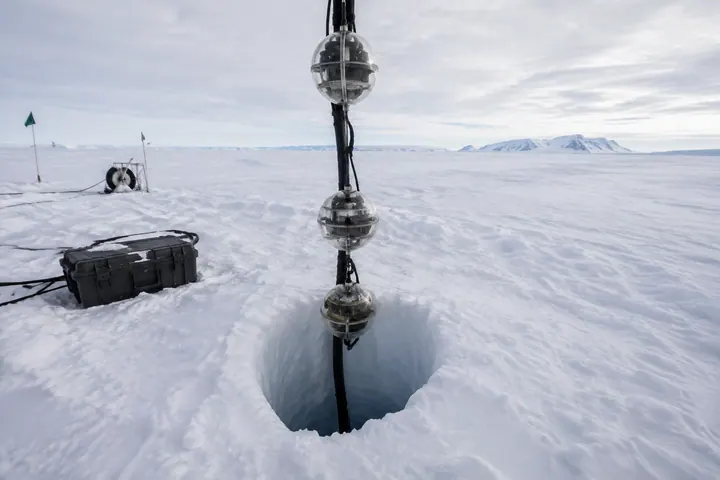
IceCube is a neutrino observatory at the South Pole in Antarctica that uses buried light sensors in ice.
The sensors register light produced when a neutrino interacts with the ice. Neutrinos' low rate of interaction makes them extremely difficult to detect. Because they interact so rarely with matter, they can help researchers trace them back to the energetic events that produced them.
From construction to discovery
- 2011: The observatory was completed at a cost of US$271 million, Nature reported.
- 2013: IceCube made its first detection of high-energy neutrinos of astrophysical origin.
- 2017: It helped identify the first definitive source associated with a single high-energy cosmic neutrino: a blazar called TXS 0506+056.
IceCube's observations are also used alongside other kinds of astronomical evidence. Scientific American reported that the observatory has contributed to multimessenger astronomy by pairing neutrino measurements with electromagnetic and gravitational-wave observations.
Halzen said he was sure neutrino astronomy would deliver unexpected discoveries over the next 50 years. He grounded that forecast in astronomy's history, arguing that opening new observational windows on the universe has repeatedly produced discoveries researchers had not anticipated.
Recognition and funding
Ars Technica reported that the National Science Foundation had committed $53 million (£40.1 million) to maintain IceCube operations over the next five years.
Scientific American reported a separate proposal to halve IceCube's US funding. The proposal could place the project under financial pressure.
Michael Moloney argued that IceCube demonstrates the value of ambitious publicly funded science, showing that audacious experimental designs can produce extraordinary discoveries.
Sources
17 reports from 16 outletsFrom Shropshire Star, Financial Times, Edinburgh Evening News and 13 more
Shropshire Star2
Al Jazeera
Ars Technica
BBC
Edinburgh Evening News
Financial Times
Fortune
Hacker News
Nature
New Scientist
New York Times
NPR
Science
Scientific American
The Guardian
Wired
How this story was made. Drafted with AI from 17 reports by 16 outlets. Each highlighted line in Claims Mode links to the reporting behind it. Debate level shows how sharply the positions reported in a story conflict. Source tone shows how much of our account rests on checkable facts and on-record quotes rather than interpretation. Both are scored by our model from our account of the coverage, out of 100, as in the app. How we make stories · Corrections · Spotted an error? Tell us