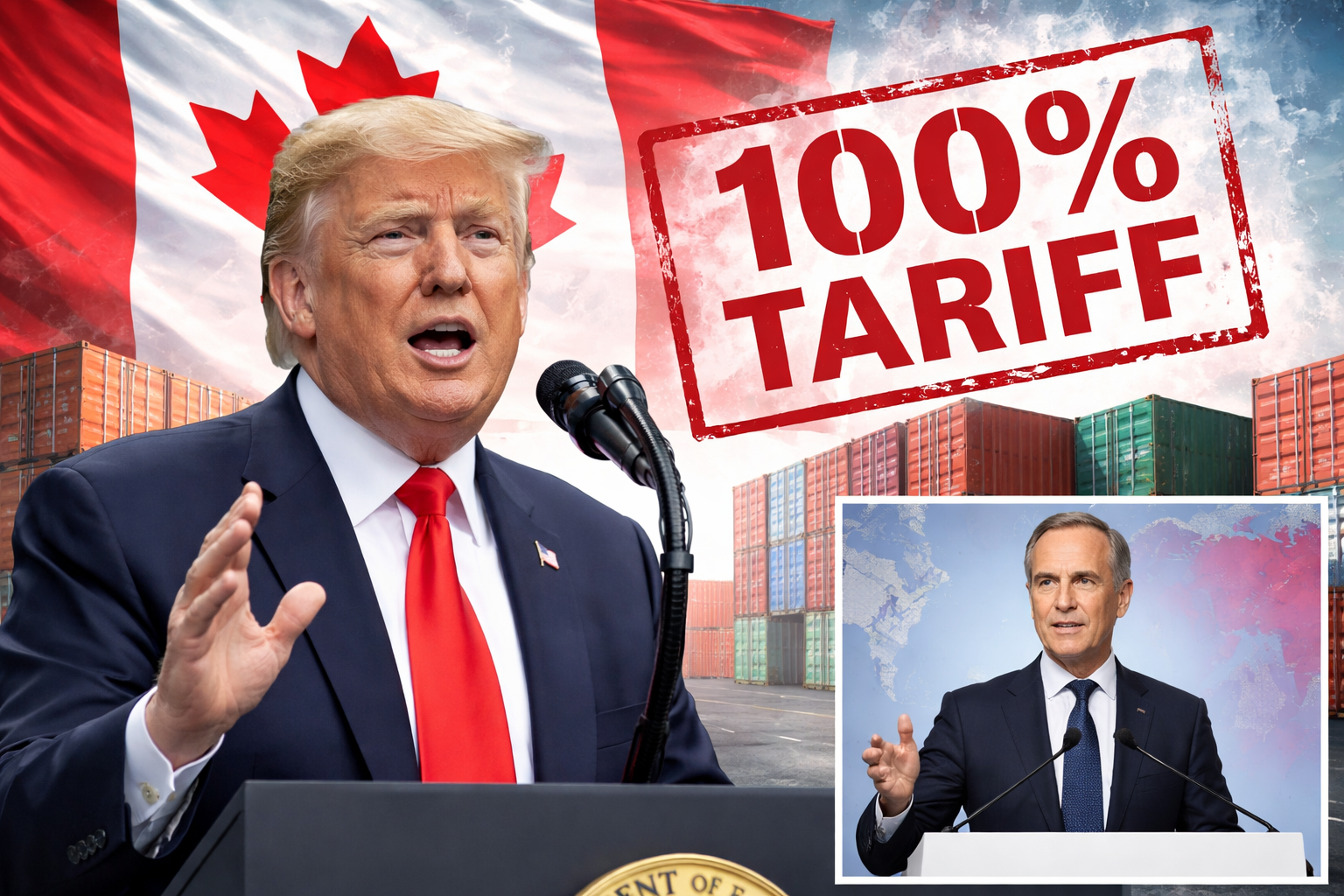
Trump threatens 100% tariffs on Canada over potential China deal and diplomatic dispute followed after President Donald Trump posted on Truth Social: "If Canada makes a deal with China, it will immediately be hit with a 100% Tariff against all Canadian goods and products coming into the U.S.A."
If Canada makes a deal with China, it will immediately be hit with a 100% Tariff against all Canadian goods and products coming into the U.S.A.
In the same Truth Social thread he alleged, "If Governor Carney thinks he is going to make Canada a 'Drop Off Port' for China to send goods and products into the United States, he is sorely mistaken," and he speculated that "China will eat Canada alive, completely devour it, including the destruction of their businesses, social fabric, and general way of life."
What the Canada-China agreement would do
Mark Carney described a package of trade changes with China, saying, "Under the agreement reached between Carney and Chinese President Xi Jinping last week, China will lower levies on Canadian canola oil from 85% to 15% by March, while Canada will tax Chinese EVs at the most-favoured-nation rate, 6.1% – down from 100%." He also said, "Ottawa, in return, will allow 49,000 Chinese EVs into the Canadian market."
Canada's U.S. trade minister Dominic LeBlanc said in a statement, "There is no pursuit of a free trade deal with China."
U.S. reactions and mixed signals
Earlier, at the White House on Jan. 16, Trump told reporters, "That's what he should be doing. It's a good thing for him to sign a trade deal. If you can get a deal with China, you should do that."
That earlier encouragement sits in stark contrast with his later Truth Social warning of a 100% tariff on Canadian goods.
In August 2025, Trump raised the tariff on Canadian goods to 35%.
Trump said, "Canada lives because of the United States." Mark Carney, speaking in Davos, countered, "Canada doesn't live because of the United States. Canada thrives because we are Canadian."
Matthew Holmes, executive vice president and chief of public policy at the Canadian Chamber of Commerce, said, "Canada's government has transparently outlined that the agreement with China is fundamentally about domestic consumers and businesses in Canada and China, not schemes aimed at other markets." Daniel Béland, a political scientist at McGill University, said, "there was a sense Trump showed more respect for Carney than for Trudeau. Now, after Carney's visit to China and, even more, his widely celebrated Davos speech, which clearly outshined and upset Trump, the gloves are off."
Economic stakes and numbers
Those figures underline why analysts warned that if the United States were to curtail access to Canadian products 'it would have sweeping consequences for its northern neighbour.'
Trump also used Truth Social to withdraw a previously extended invitation, writing, "Dear Prime Minister Carney, Please let this Letter serve to represent that the Board of Peace is withdrawing its invitation to you regarding Canada's joining, what will be, the most prestigious Board of Leaders ever assembled, at any time."
Middle powers must act together because if you are not at the table, you are on the menu.
At Davos Carney argued that the US-led world order had been ruptured and framed the deal as part of a strategy for middle powers to coordinate their interests.
State of play
Reporting across outlets agrees that Mark Carney announced an arrangement with China that would lower levies on Canadian canola oil from 85% to 15% by March and reduce duties on Chinese electric vehicles; Carney said Ottawa expects those canola tariffs to fall by 1 March. President Trump has publicly warned of a possible 100% tariff and in August 2025 raised the tariff on Canadian goods to 35%. Canada's U.S. trade minister Dominic LeBlanc said, "There is no pursuit of a free trade deal with China." Business groups and analysts, including Matthew Holmes, said, "Canada's government has transparently outlined that the agreement with China is fundamentally about domestic consumers and businesses in Canada and China, not schemes aimed at other markets," and the BBC observed the deal could see "more Chinese investments in Canada." NPR cautioned that a U.S. posture that "does not need access to any Canadian products" could, as it warned, "have sweeping consequences for its northern neighbour." The principal disputes are over the scope of Canada's engagement with China and how Washington will respond; most reporting points to further diplomatic exchanges and monitoring of tariff moves as the next steps.
Built from coverage across multiple outlets and regions.
How this page is made
This page is written from dozens of outlets covering the same event, mixing local and international viewpoints to show the full picture and add context you might otherwise miss. It aims to show where outlets agree, where they report different details, and where opinions diverge, with supporting evidence for key claims and a full source list.
We’re launching The Bias on iOS soon. If you’d like to help beta test the app, reach out on Instagram @thebias_app or email sam@thebias.co.uk.
All sources
- Daily Mail - NewsTrump threatens Canada with ONE HUNDRED per cent tariffs and warns nation will be 'eaten alive' in deal with China
- CNBC - TopTrump threatens to impose 100% tariff if Canada makes deal with China
- New York Times - WorldTrump Threatens Canada With Tariffs as Post-Davos Fallout Continues
- BBC - WorldTrump threatens Canada with 100% tariffs if it 'makes a deal with China'
- RTE - Ireland NewsTrump threatens Canada with 100% tariff over China trade
- The Independent - WorldTrump threatens Canada with 100% tariffs over ‘drop-off’ deal with China
- Washington Post - WorldTrump threatens 100 percent tariffs on Canadian goods over China deal
- Derby TelegraphMayor 'very worried' for Rolls-Royce and other firms after Trump tariff threat
- NPR - NewsTrump threatens Canada with 100% tariffs over its new trade deal with China
- Bloomberg - PoliticsTrump Threatens 100% Tariffs on Canada If It Does China Deal
- PBS NewsHour - HeadlinesTrump threatens Canada with 100% tariffs over its new China trade deal
- Financial Times - LatestTrump threatens 100% tariffs on Canada if it seals trade deal with China