CES 2026: Physical AI steals the show
CES 2026 in Las Vegas tilted heavily toward "physical AI", with companies moving large language models and computer vision into machines that walk, carry out chores or handle delicate objects. Exhibits spanned chore-focused home helpers, robot vacuums that can climb staircases and humanoid prototypes demonstrating dexterous hands. Some vendors pitched devices as near-sale products while others remained costly prototypes and concepts. Coverage mixed excitement and scepticism: praise for new capabilities arrived alongside warnings about safety, data and practicality.
What the show floor delivered
On the show floor the dominant categories were household chore robots, upgraded robot vacuums, dexterous humanoids and companion devices. Robot vacuums arrived this year with new architectures — extendable arms, roller mops, climbing legs and modular wash-and-dry attachments — while companion machines ranged from wearable pocket pets to full-size AI dolls. Many companies presented near-production hardware alongside looser concept demos at booths and in keynotes.
Household chores: laundry, folding and kitchen help
LG demonstrated CLOiD, a torso-on-wheels home assistant integrated with ThinQ that the company showed performing tasks such as folding laundry, cooking and emptying dishwashers. Switchbot and a number of smaller companies displayed laundry-handling robots: Switchbot's Onero H1 was shown loading clothing items in live demos but multiple reporters said the machine moved slowly, sometimes taking close to two minutes to pick up and load a single garment. Switchbot told Engadget that it expects to sell Onero in 2026 and suggested a price under $10,000, while some reviewers called the booth models proof-of-concept rather than consumer-ready.
Not all folding solutions were pitched as consumer products: Sky News reported a hotel-focused laundry-folding robot that requires days of remote adaptation and is already being rented commercially to hotels at roughly $3,000–$5,000 per month.
Robot vacuums: arms, legs and suction wars
Robot vacuum makers leaned on new mechanical ideas and bigger suction figures. Roborock promoted Saros 20 models it said have market-leading 35,000 Pa suction; Dreame showcased the X60 Max Ultra and other units and reintroduced an arm-equipped Cyber 10 Ultra that the company says can lift items up to 500 grams; Narwal and others emphasised roller-mop designs with strong suction figures too.
Roborock also demonstrated a prototype called the Saros Rover — a wheel‑leg design the company says is a real product in development and intended to climb and clean stairs — while Dreame and others showed legged or tracked concepts that remain at the prototype stage. Startups pushed different approaches too: Robotin's R2 uses modular front modules so the same base can vacuum or wash carpets, and in CNET's demo the firm said the R2 takes around an hour to wash a carpet and about two hours to dry it, with a large base station holding clean and dirty water.
Not all reporting aligned
On some technical details outlets reported different figures: for example Mashable published a Saros 'threshold climbing max' of 3.3 inches for the Roborock Saros, while ZDNet reproduced Roborock's documentation and reported a 1.77-inch threshold figure for the same series.
Humanoids, hands and keynote context
We will have robots with human capabilities "this year", he said, "because I know how fast the technology is moving".
Huang's comment encapsulated a keynote-heavy message that TechCrunch and others noted as a driver of the 'physical AI' push; at the same time several reporters emphasised the engineering gaps that remain, including balance, fluid motion and the ability to adapt in messy home settings.
Demos: fights, ping-pong and dextrous hands
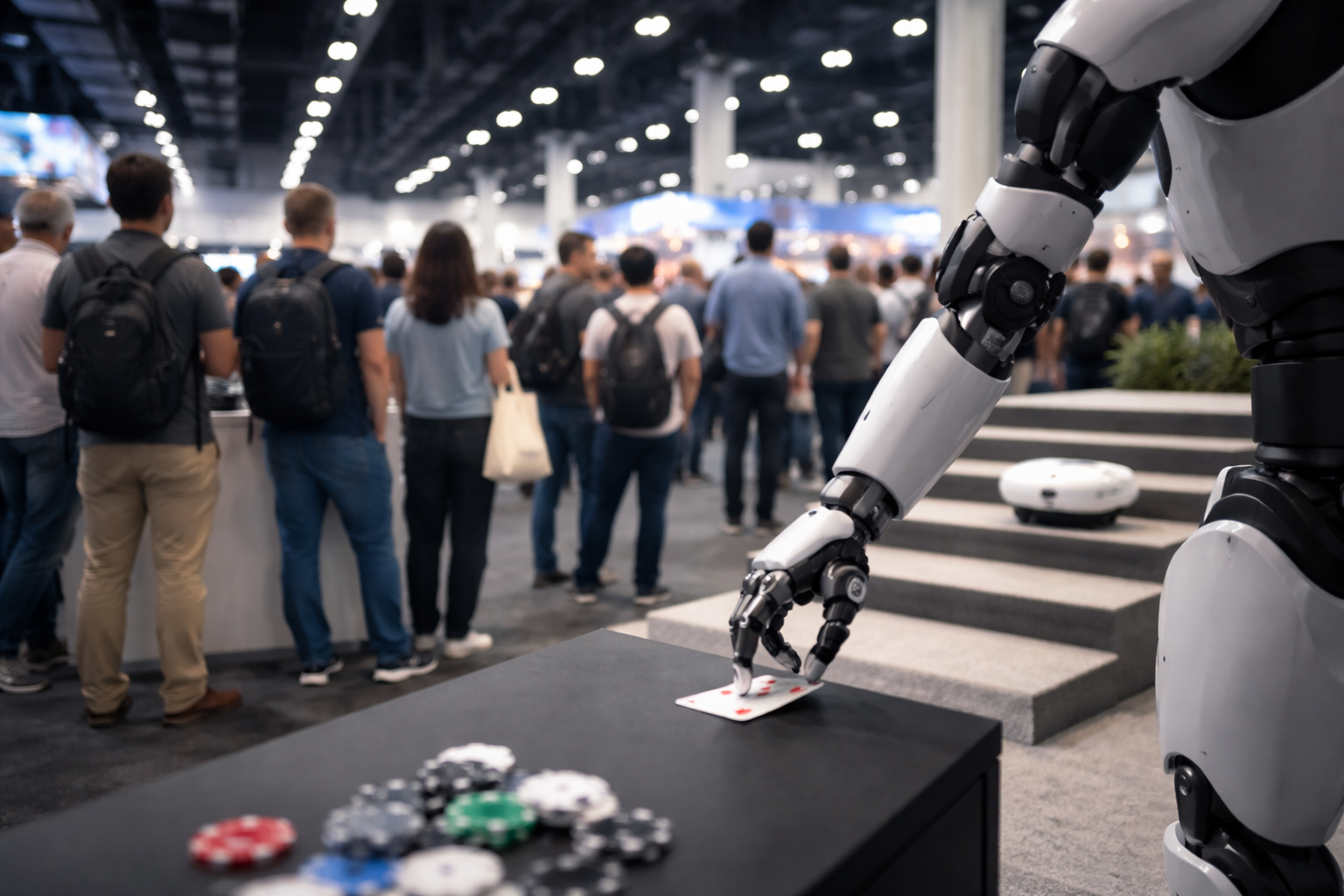
Some stands leaned on spectacle to prove progress: Sharpa's humanoid played ping-pong and dealt blackjack while its SharpaWave hand showed 22 degrees of freedom and fine tactile sensing; Sky News staged an on‑stage scuffle with a Unitree G1 that the reporter said the machine recovered from but could not match human evasiveness.
Companions: cute pets, pocket bots and intimate dolls
Companion devices ranged from toy-like pocket pets to controversial full-size dolls. Engadget and several outlets showed OlloBot and tiny AI companions that store memories locally, while Lovense's life-size AI 'Emily' drew attention both for its conversational memory features and for security caveats raised by reporters about the company's past data incidents.
Other notable demos and gadgets
The vehicle and mobility space had its share of physical AI work: Sony Honda Mobility re-presented the AFEELA 1 with a sweeping interior display and a starting price that Engadget reported as $89,900 and with limited deliveries planned for late 2026 in California. Brunswick showed AutoCaptain self-docking and an on-boat agent called Misty and listed a Sea Ray SLX 360 Outboard with a six‑figure starting price, while Beatbot unveiled the AquaSense X pool cleaner with an auto-emptying 22‑liter station and a $4,250 preorder price. Dephy demonstrated a powered 'Sidekick' shoe exoskeleton for walking assistance priced at about $4,500.
Reports and disagreements
Across outlets there was both overlap and divergence: some numerical specs and climbing figures differed between reports, release timetables were described with varying confidence, and reviewers' read on 'ready-for-market' status was inconsistent. Where a single company gave a timeline or price in an interview, some outlets repeated that as near-certainty while others treated it as a tentative claim or a prototype-stage promise.
Reactions and implications
Coverage ranged from enthusiasm about concrete utility to frank scepticism. TechCrunch and several show-floor teams framed CES as a turning point for embodied AI and emphasised vendor keynotes and compute roadmaps, while Engadget, Mashable and CNET highlighted useful household advances. By contrast, Sky News and some CNET pieces argued humanoid 'butlers' remain distant; reviewers such as CNET's Ajay Kumar described certain laundry demos as impressively inventive but practically immature; independent writers flagged privacy and data risks around companion dolls; and analysts noted many products will enter staged trials, limited deliveries and early pre-orders through 2026 and into 2027.
State of play
Reporters broadly agree CES 2026 was dominated by demonstrations of 'physical AI' and by a flood of household robots, robot vacuums and humanoid prototypes; companies including Roborock and Dreame published high suction and stair-climb specs and gave release windows, Switchbot and Dreame offered sale-year targets or target months while Robotin gave early-backer and mass-production timing for its modular carpet washer, but some numeric specifics and readiness claims differ between outlets. Observers allege privacy, safety and battery-life remain pressing unresolved issues for many devices, and next steps reported by vendors and outlets include staged trials, limited pre-orders and region-limited deliveries stretching through 2026 and into 2027.
How this page is made
This page is written from dozens of outlets covering the same event, mixing local and international viewpoints to show the full picture and add context you might otherwise miss. It aims to show where outlets agree, where they report different details, and where opinions diverge, with supporting evidence for key claims and a full source list.
We’re launching The Bias on iOS soon. If you’d like to help beta test the app, reach out on Instagram @thebias_app or email sam@thebias.co.uk.
All sources
- CNETYour AI Girlfriend Has a Body and Memory Now. Meet Emily, CES's Most Intimate Robot
- ABC News - Top StoriesWATCH: Dancing robot gets too funky at CES
- CNETI Watched a Robot Slowly and Inefficiently Load Laundry at CES
- CNETI Watched a Drone Pick Up a Robot Vacuum and (Sort Of) Carry It Up the Stairs at CES 2026
- TechCrunch - AICES 2026: Follow live for the best, weirdest, and most interesting tech as physical AI and robots dominate the event
- EngadgetI can't get over this goofy, long-necked 'cyber pet' robot at CES
- GizmodoBeatbot Announces Two New Smart Pool Cleaners and a Major Rebrand at CES 2026
- ABC News - Top StoriesWATCH: Tri-fold phones and humanoid robots: Top innovations at CES 2026
- The Guardian - TechnologyRobots that can do laundry and more, plus unrolling laptops: the standout tech from CES 2026
- CNETCES 2026: We Found the Robots That Actually Solve Real Housework Problems
- EngadgetThe robots we saw at CES 2026: The lovable, the creepy and the utterly confusing
- EngadgetSharpa's ping-pong playing, blackjack dealing humanoid is working overtime at CES 2026
- TechCrunch - AICES 2026 was all about ‘physical AI’ and robots, robots, robots
- TechCrunch - AICES 2026: Follow live for the best, weirdest, most interesting tech as this robot and AI-heavy event wraps up
- Sky News - Technology'I fought a humanoid robot and won - this is why physical AI can't replace us yet'
- EngadgetDreame's robot vacuum with an arm is back at CES 2026 and it can do more than pick up shoes
- EngadgetLovense launches an AI 'companion doll' at CES
- LifehackerCES 2026: 'Rescue Retriever' Wants to Help Firefighters Save Your Pets
- MashableRoborock dropped 3 new robot vacuums at CES 2026. Of course they set a new suction power record.
- CNETThe World’s First Carpet-Washing Modular Robot Vacuum Might Come From an Unknown Startup I Saw at CES
- EngadgetBrunswick's latest boats at CES 2026 feature edge AI, self-docking capabilities and solar power
- EngadgetThese robotic sneakers gave me a surprising boost at CES
- EngadgetAt CES 2026, Sony Honda Mobility's latest Afeela 1 still feels woefully out of date
- EngadgetSwitchbot came to CES with a laundry robot you might actually be able to buy
- LifehackerCES 2026: WheelMove Turns Any Standard Wheelchair Into an Electric One
- MashableCES 2026: Sonys AFEELA 1 EV is back and road ready
- MashableCES 2026: All of the big robot vacuum announcements, from new suction power records to... another arm
- ZDNetI saw a two-legged robot vacuum climb up stairs at CES, and blew my mind away