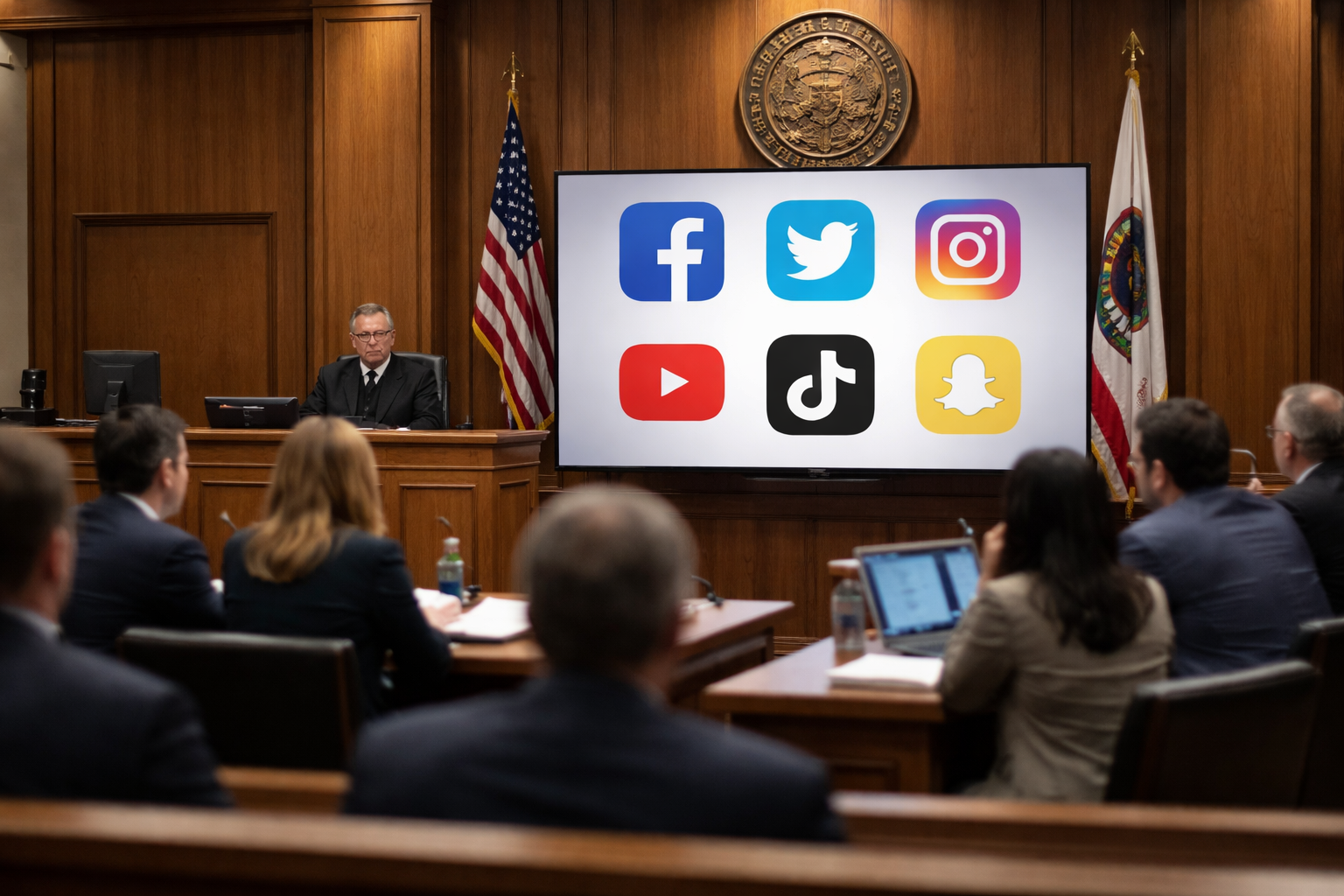
Landmark US trial begins testing whether social media platforms are addictive and harm children opened in Los Angeles this week, multiple news outlets reported, centering on claims that platform design choices create compulsive use and damage young people's mental health. The lead plaintiff, identified only by the initials K.G.M., alleges the platforms' design left her addicted and harmed her mental health.
What the plaintiffs allege
K.G.M. is described in court papers as a 19-year-old whose complaint says she began using social media around age 10 despite her mother's efforts to block the apps. The complaint seeks monetary damages and wants court-ordered changes to how major apps are built.
Defendants' response
Meta, Google and TikTok have said they 'strongly disagree' with the allegations and deny responsibility for the harms alleged. The companies have also argued that Section 230 of federal law and the First Amendment limit any legal responsibility and that no clinical diagnosis of social-media addiction or direct causal link to mental-health decline has been established.
the existing body of scientific work has not shown any causal link between social media and young people having worse mental health outcomes
Zuckerberg used that wording while testifying to US senators in 2024 and is reported to have apologized to victims during that hearing.
Judge's ruling and legal framing
Judge Carolyn Kuhl has struck some claims aimed at third-party content but said jurors should decide whether features like infinite scrolling could contribute to harming users.
Unsealed internal documents
lol, we're basically pushers
Mary Graw Leary, a law professor, said that much of what companies have tried to keep private is likely to be aired in court. Plaintiffs' lawyers and observers expect troves of internal material to emerge as the trials proceed.
Size and scope
The Guardian's reporting counts roughly 1,600 plaintiffs and places hundreds of families and school districts in the tally. By contrast, NPR said the coordinated state cases were brought by more than 1,000 individual plaintiffs, hundreds of school districts and dozens of state attorneys general.
Witnesses and schedule
Key witnesses expected include Meta CEO Mark Zuckerberg and Instagram head Adam Mosseri, with Zuckerberg due to testify early in the process.
Settlements and secrecy
Snap reached a settlement with the plaintiff shortly before the trial and said the matter was resolved amicably. Sacha Haworth of the Tech Oversight Project said parties typically settle when they do not want sensitive material exposed, suggesting the public may not yet appreciate what could be revealed.
Legal analysis and stakes
Matthew Bergman, an attorney for the plaintiffs, described the algorithms as dangerous and addictive and said companies will have to explain to a jury why profits were more important than the lives of young people. Eric Goldman, a law professor, countered that the plaintiffs' legal theory is flawed, argued it raises novel legal questions and warned that losing these cases could pose an existential threat to the social media companies.
Mary Anne Franks, a law professor, said the tech industry has long received deferential treatment and that this is beginning to change, adding that tech executives often do not perform well under courtroom pressure.
Business moves and speculation
Separately from the litigation, Meta said it would test premium subscription tiers for Instagram, Facebook and WhatsApp that the company said are expected to unlock greater productivity, creativity and expanded AI capabilities. In December the company bought Manus, a Singapore-based developer of AI agents founded in China, in a deal reported at about $2 billion. The Financial Times reported that Chinese officials were reviewing the acquisition for possible technology-control or national-security violations. CNBC has speculated that Meta could be seeking a return on its AI spending by monetising new subscription plans. Mashable noted that when paid tiers are introduced, free versions often get left behind in features and upgrades. TechCrunch suggested the subscriptions could add revenue but may confront user subscription fatigue.
State of play
Multiple outlets agree the landmark US trial has begun in Los Angeles and is centered on whether platform design choices contributed to addiction claims. Snap reached an amicable settlement with the plaintiff shortly before the trial. Judge Carolyn Kuhl has struck some claims about third-party content but left jurors to decide whether features such as infinite scroll could contribute to harming users. Plaintiffs, led by a 19-year-old identified as K.G.M., allege addictive design and say they suffered mental-health harms. They are seeking monetary damages and court-ordered changes to app design. The companies have rejected the allegations. They have argued that Section 230 and the First Amendment limit liability and that no clinical diagnosis proving social-media addiction or direct causation has been established. Observers say that if plaintiffs prevail, the outcome could force substantial changes to platform design and open new avenues for litigation. The immediate next steps include testimony from senior executives, with Mark Zuckerberg and Adam Mosseri expected to appear and Zuckerberg due to testify early.
Built from coverage across multiple outlets and regions.
How this page is made
This page is written from dozens of outlets covering the same event, mixing local and international viewpoints to show the full picture and add context you might otherwise miss. It aims to show where outlets agree, where they report different details, and where opinions diverge, with supporting evidence for key claims and a full source list.
We’re launching The Bias on iOS soon. If you’d like to help beta test the app, reach out on Instagram @thebias_app or email sam@thebias.co.uk.
All sources
- BBC - TechnologyTech giants face landmark trial over social media addiction claims
- MashableFacebook and Instagram might get paid subscription tiers soon
- NPR - NewsMeta, TikTok and YouTube are on trial over whether their apps hurt children
- New York Times - TechnologyThe Social Media Addiction Trials: What to Know
- New York Times - TechnologySocial Media Giants Face Landmark Legal Tests on Child Safety
- New York Times - HomeTrump Changes Course in Minneapolis, and Social Media Giants Face Big Tobacco-Style Lawsuits
- The Guardian - WorldTech giants head to landmark US trial over social media addiction claims
- The Hill - TopSweeping social media addiction lawsuit heads to trial
- Daily Star - NewsSocial media addiction is 'fuelling the rise in youngsters taking ketamine'
- GizmodoLooking for More Paid Social Media Features? Meta Is Reportedly Testing Tons
- CNBC - TopMeta to test premium subscription plans for Instagram, Facebook and WhatsApp
- TechCrunchMeta to test premium subscriptions on Instagram, Facebook, and WhatsApp
- BBC - TechnologyInstagram, Facebook and WhatsApp to trial premium subscriptions