Multiple independent sources and documents substantiate key claims.
Divisiveness
Most outlets agree on the basics; some difference in emphasis or conclusions.
How we rate this
We leverage large language models and clustering methods to assess how closely outlets agree on core facts and how much interpretations diverge. Scores reflect the dispersion of claims and the strength of sourcing across multiple outlets.
Claim mode on, tap a claim to see its source
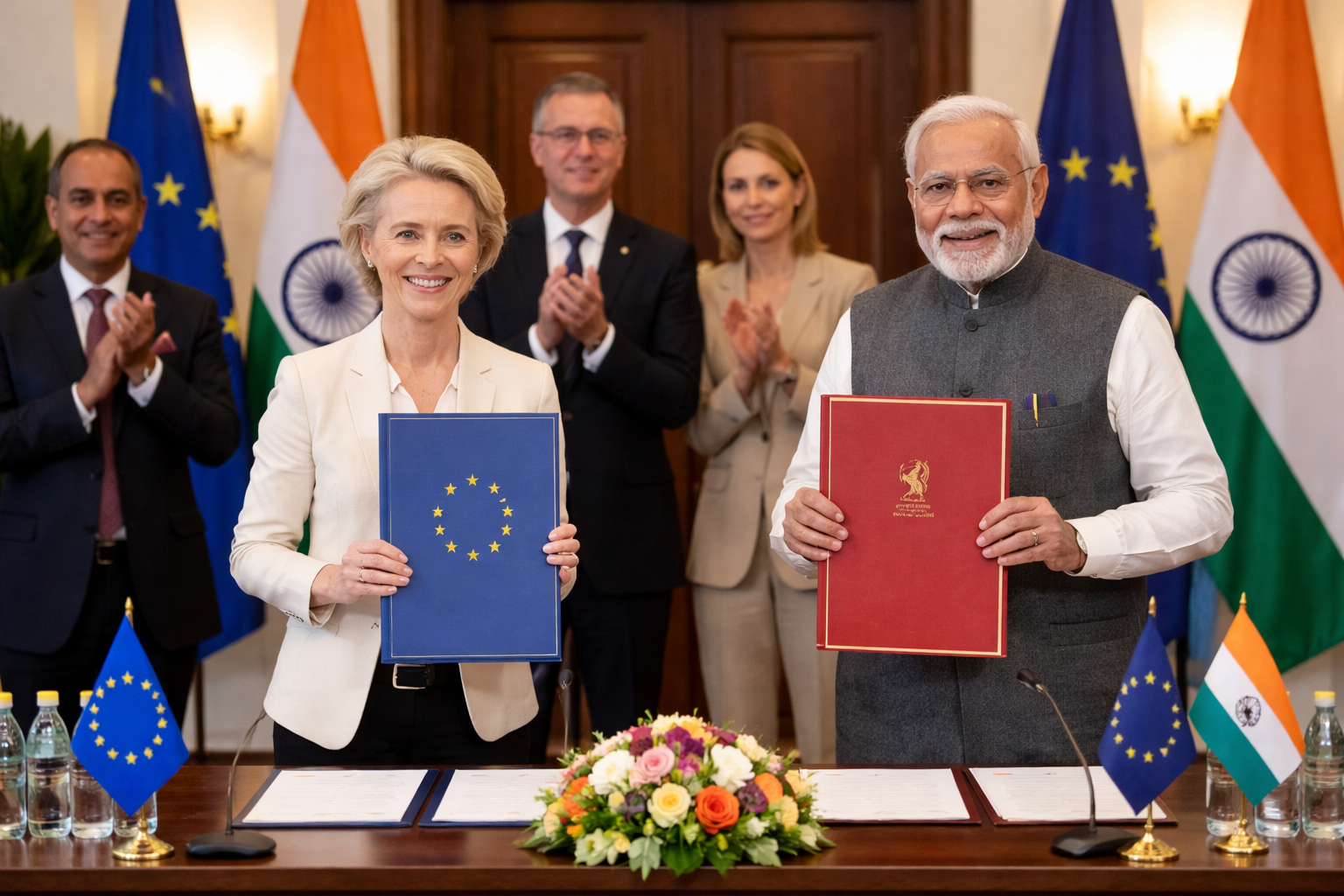
EU and India sign 'mother of all' free-trade deal, an agreement their leaders presented as creating a free trade zone of two billion people. Officials said the pact covers about 25 percent of global gross domestic product. European Commission president Ursula von der Leyen described it as 'the mother of all deals' and Prime Minister Narendra Modi called it India's biggest free trade agreement.
We have concluded the mother of all deals. We have created a free trade zone of two billion people, with both sides set to benefit.
— Ursula von der Leyen, European Commission president
EU officials said the pact would eliminate or reduce tariffs on about 96.6 percent of EU goods exports to India, a change Brussels expects will double EU exports to India by 2032. Officials added the agreement could save roughly €4 billion a year in duties for European companies. The deal also aims to reduce tariffs to zero for a wide range of industrial products, including nearly all iron and steel, plastics, chemicals, machinery and pharmaceuticals.
Motor-vehicle duties, currently as high as 110 percent, would be cut gradually and ultimately fall to 10 percent under a quota of 250,000 vehicles a year.
2,000,000,000
Combined market population
Approximate combined population of the EU and India
The two-billion figure refers to the combined population of the EU and India, as officials framed the market for the deal.
How the deal will be implemented
An Indian government official told Reuters that the formal signing will take place after legal vetting expected to last five to six months and that the deal could be implemented within a year. Formal trade talks were first launched in 2007, stalled in 2013 and were formally restarted in July 2022. EU figures show bilateral goods trade has grown nearly 90 percent over the past decade to €120 billion in 2024, with a further €60 billion in services.
Safeguards and cooperation
Delhi said it had prudently safeguarded sensitive sectors including dairy, cereals, poultry, soy meal and certain fruits and vegetables. A joint statement said India and the EU had signed an accord to improve regulatory cooperation in financial services. Officials also announced a security and defence partnership and agreed a mobility framework to ease short-term professional travel between India and the EU.
The Bias
Modern news forces a trade-off: one lens or ten tabs. The Bias is the wide-angle view — key facts and major perspectives in one read. Instead of headlines and hot takes, we pull together what different outlets are actually saying — and where their reporting starts to differ. Most stories include an international outlook, showing what overseas coverage is emphasising.
Get the wide-angle view on iOS — without ten tabs
We’ll email you first when it’s ready — plus new wide-angle briefings.
Several industry and policy voices welcomed the pact. The European carmakers' association said it will greatly help European automobile exports. Thilo Brodtmann of Germany's VDMA described the agreement as a 'day of celebration for export-oriented mechanical engineering'. Hosuk Lee-Makiyama said the deal is a 'deal that they can do that will have a positive impact'. Economist Mitali Nikore warned India's manufacturing sector might not be fully prepared for strict EU environmental and carbon mechanisms, and Andrew Small of the European Council on Foreign Relations said the agreement is a building block rather than the 'super maximally ambitious' deal once envisioned.
Market and strategic consequences
Markets reacted quickly: European stocks rose after the deal was announced. Analysts said the tariff changes would give European automakers greater access to India's car market and boost automobile exports. For India, former trade official Ajay Srivastava and other analysts said tariff cuts should expand labour-intensive exports such as textiles, shrimp and gems and jewellery, partly offsetting the impact of recent U.S. tariffs. Officials and analysts also said the agreement will deepen the strategic partnership and may encourage India to diversify defence suppliers away from Russia.
Uncertainties and next steps
Observers flagged open questions. CNBC reporting said there is uncertainty about how U.S. President Donald Trump might react to the agreement. The Guardian and some analysts speculated the negotiations were accelerated over recent months in reaction to heavy U.S. tariff threats. BBC reporting and commentators warned there may be political or parliamentary hurdles in EU member states and the European Parliament before ratification. Analysts and economists also speculated that India could face challenges complying with strict EU regulations and carbon standards.
State of play
Across outlets and officials there is agreement that the EU and India have reached a major trade and strategic package that, according to EU and Indian statements, creates a combined market of roughly two billion people and would eliminate or reduce tariffs on about 96.6 percent of EU goods exports to India. Indian and EU officials say the pact reduces or removes duties on many industrial products and significant portions of traded goods, and an Indian official has indicated the formal signing will follow legal vetting expected to last five to six months. Analysts and industry groups claim the deal will boost European exports and give automakers better access to India, while some economists and observers caution about India meeting strict EU regulatory standards and about possible parliamentary hurdles before ratification. Next steps reported include legal vetting, parliamentary approval processes in the EU and national steps in member states, with implementation reportedly targeted within about a year.
International Outlook
Swipe to see how overseas media are framing the story and what domestic news is not reporting.Scroll to see how overseas media are framing the story and what domestic news is not reporting.
India
Sources
Indian Express, News18 India, Republic World - Business, India Today
Indian outlets emphasised details often absent from UK summaries: negotiators secured a 'forward‑Most Favoured Nation' clause on the EU's CBAM, and officials say India won an understanding to ease access to EU steel scrap for low‑carbon steel production while retaining a rebalancing mechanism to impose reciprocal costs if needed.
Forward‑MFN on CBAM: negotiators secured a 'forward‑Most Favoured Nation' clause on the EU carbon border mechanism.
Steel scrap access: India applied to receive scrap under the EU’s recycling policy, officials say an 'understanding' was reached and a rebalancing mechanism is available.
Services & investment openings: FTA opens access to 144 EU service subsectors and unlocks 102 Indian sectors to EU investment.
Mobility specifics: assured market access for contractual service suppliers across 37 sectors; commitments for independent professionals in 17 sectors; social‑security cooperation and a 9–12 month job‑search window for Indian graduates from EU institutions.
Trade scale: Commerce Minister Piyush Goyal said exports estimated at Rs 6.4 lakh crore will gain access to 27 EU markets under the single framework.
Security alert and market reaction: intelligence agencies warned of Khalistani threats around Republic Day; Indian automaker shares fell (Hyundai ~4%, Maruti ~1.4%, Mahindra ~4.2%; Nifty Auto −0.9%); analysts forecast modest near‑term volume hits (M&M ~3–4%; smaller players ~1–2%).
Taken together, Indian coverage frames the pact as expansive on services and skilled‑worker mobility while preserving calibrated safeguards for steel and autos — reporting concrete numeric clauses and immediate market moves rather than solely high‑level strategic language.
Western Europe
Sources
taz (Germany), eldiario.es (Spain)
German and Spanish outlets emphasised defence and technical car‑market details: German reporting outlined the partnership's security scope and noted India's ongoing defence ties to Russia; Spanish reporting gave a technology‑by‑technology breakdown of the car quota and its phasing.
Security scope: partnership covers maritime and cyber security, protection of critical infrastructure, information exchange and space security.
India–Russia defence ties: taz noted an existing defence cooperation agreement runs to 2031 covering joint development, production and maintenance of Russian military equipment in Indian service.
Vehicle quota breakdown: the 250,000‑car quota is segmented by technology (160,000 combustion; 90,000 EVs), phased over ten years for combustion engines and 14 years for EVs, with EV volumes staged from year five (starting 27,500 units and rising to 125,000).
These reports present the deal as pairing a security‑focused partnership with tightly phased, technology‑specific access for EU cars and as mindful of India's existing military relationships.
Southeast Asia
Sources
Straits Times Singapore
Singapore's Straits Times placed the India accord in a broader EU trade context and described it as less ambitious than some recent EU pacts.
Eurostat 2024 goods figures: EU trade with the United States €873 billion; with China €736 billion.
EU–Mercosur context: that agreement removes over €4 billion of annual duties and the Commission estimates it could boost EU exports to Mercosur by 39% (EU‑Mercosur goods trade €111 billion in 2024).
Comparative assessment: Straits Times said the EU–India deal does not achieve full liberalisation in sectors such as cars and excludes government procurement, energy, raw materials and certain manufacturing investment openings.
The article frames the India deal as comparatively modest on market access relative to other recent EU agreements, especially on cars and procurement.
Eastern Europe
Sources
Kommersant
Kommersant highlighted mobility provisions, reporting the pact includes measures to assist Indian students and qualified professionals and that von der Leyen said the EU will open its first legal centre in India as a single support hub for Indian specialists seeking to relocate to Europe.
Email signup
International Outlook
See what overseas outlets highlighted that domestic coverage barely mentioned — extra context, different priorities, and details that change how the story reads.
This page is written from dozens of outlets covering the same event, mixing local and international viewpoints to show the full
picture and add context you might otherwise miss. It aims to show where outlets agree, where they report different details, and
where opinions diverge, with supporting evidence for key claims and a full source list.
We’re launching The Bias on iOS soon. If you’d like to help beta test the app, reach out on Instagram
@thebias_app or email
sam@thebias.co.uk.