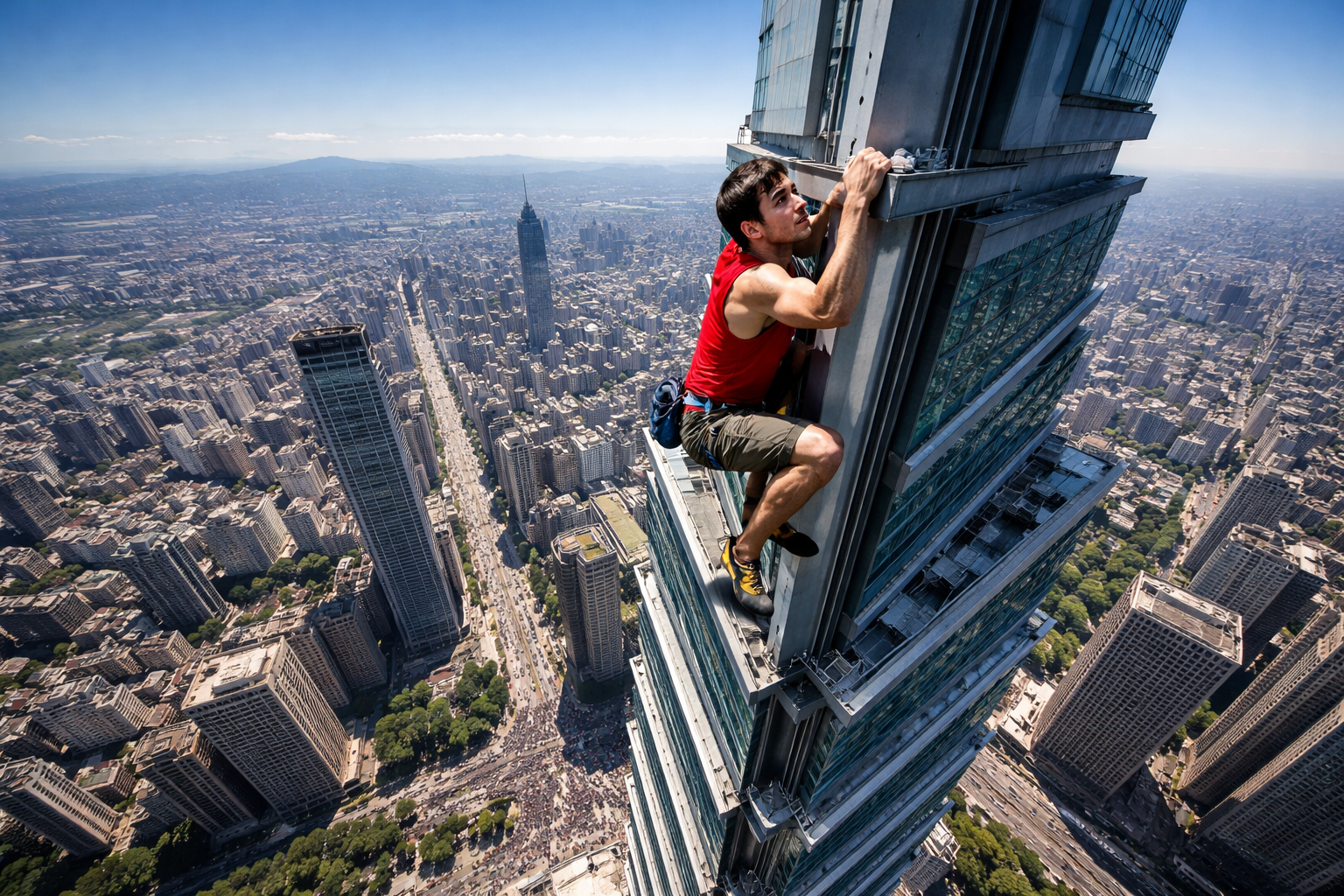
Alex Honnold climbs Taipei 101 without ropes in live Netflix challenge
Updated 5h ago3-min read77 sources
Factuality—Strong evidence
Divisiveness—Contentious
How we rate this
Factuality
Multiple independent sources and documents substantiate key claims.
Divisiveness
Significant disagreement between outlets in emphasis, framing, or conclusions.
How we rate this
We leverage large language models and clustering methods to assess how closely outlets agree on core facts and how much interpretations diverge. Scores reflect the dispersion of claims and the strength of sourcing across multiple outlets.
Claim mode on, tap a claim to see its source
Alex Honnold climbs Taipei 101 without ropes in live challenge. Street-level crowds gathered and cheered as he reached the top.
508 m (1,667 ft)
Taipei 101 height
101 floors
The ascent followed one corner of the tower and made use of small L-shaped outcroppings and the building's metal beams.
How the climb unfolded
Honnold is known for free-soloing Yosemite's El Capitan and was the subject of the documentary Free Solo.
Honnold is the first person to climb Taipei 101 without a rope; Alain Robert scaled the building in 2004 using ropes.
As he began his descent, NBC, Sky News and RTE reported Honnold put on a harness and rappelled down to a staging area where his wife, Sanni McCandless Honnold, was waiting. Daily Mail and the Manchester Evening News reported he took an elevator back down to ground level instead.
Timing and reporting
Reporting on the climb's length varied slightly: ABC and RTE cited about 90 minutes, the BBC and CBS said it took 1 hour and 31 minutes, the Manchester Evening News put the duration at 1 hour and 35 minutes, and NBC described it as 'a little over an hour and a half'.
Broadcast and scheduling
Netflix said the ascent was broadcast live on its platform with a 10-second delay, and that the attempt had been postponed for 24 hours because of rain.
Reactions and ethics debate
Supporters called the climb inspiring: Alex Honnold said he hoped people would find the push they needed to pursue their own goals, local climber Chin Tzu-hsiang said Honnold had helped fulfill dreams, and Honnold added he was not being paid to climb the building and would have done it for free.
Others voiced ethical objections: Subbu Vincent said it was unethical to livestream such a high-risk event, a Wall Street Journal columnist called the spectacle 'voyeuristic, ghoulish and irresponsible', and Jeff Smoot said that to the public it can look like thrill-seeking while climbers see a meditative art form.
The climb prompted both excitement and concern about the ethics of broadcasting a high-risk live event.
Taiwanese politicians framed the climb as a marketing opportunity that raised international attention; media critics said the event sparked backlash and renewed ethical debate over live-broadcasting dangerous stunts; some critics warned the broadcast could encourage risky behaviour among impressionable viewers and is connected to concerns about 'roof-topping' and deaths; and media analysts said the event is part of Netflix's push into live programming and may be framed as a live-sports style spectacle.
Speculation and safety considerations
Production and safety advisers suggested the 10-second live delay could be used to stop the broadcast immediately if something went wrong, others said the climb would not proceed in bad weather, and some critics speculated about Honnold's motives now that he is married with children.
It was like what a view, it’s incredible, what a beautiful day,
— Alex Honnold
Honnold made the remark after the climb, describing the view and the day.
State of play
Multiple outlets reported that Alex Honnold climbed Taipei 101 without ropes and that the ascent was broadcast live on Netflix with a 10-second delay. Opinion is divided: some described the climb as inspiring while others called the livestream unethical or 'voyeuristic', there remains a substantive dispute over whether Honnold rappelled to a staging area where his wife waited or returned by elevator, and media analysts say Netflix's live-sports push may prompt more spectacles.
International Outlook
Swipe to see how overseas media are framing the story and what domestic news is not reporting.
Taiwan
Sources
Liberty Times (Taiwan), Newtalk (Taiwan)
Taiwanese reporting supplied many details not emphasised in the UK synthesis: local climbing gyms reported a surge of inquiries after the live stream and a coach published a 10‑exercise training routine (push‑ups; pull‑ups; wide‑grip lat pulldown; skull crushers/lying triceps extensions; resistance‑band work; front raises; single‑arm dumbbell rows; kettlebell swings; planks; bar swings). Veteran climber Alain Robert rated Taipei 101 about 6.5–7 on his 1–10 scale. Private forecaster WeatherRisk said it monitored conditions for a month and advised producers; organisers arranged Republic of China flags and Netflix explicitly labelled the feed 'Taiwan Taipei'. Viewers also noticed a prominent Nan Shan Life rooftop advert at peak viewership, Polymarket paid US$4,439,390 to bettors who picked 1h30–1h45, Netflix later shared Honnold's summit selfie, and Honnold said he'd wanted the climb for about 13 years.
Stop! We will do it! We must do it!
— Janet Chia, chair, Taipei 101
Executive producer James Smith recounted pitching the idea about a year earlier and said Chia's abrupt approval green‑lit the project; Taiwanese coverage framed the deliberate 'Taiwan Taipei' labelling and flag placement as an explicit effort to maximise international visibility.
Western Europe
Sources
ZDF Heute, Tagesschau (ARD), La Vanguardia, Neue Zürcher Zeitung (NZZ), Observador (Portugal)
German, Spanish, Swiss and Portuguese outlets added technical and preparation details not highlighted in the UK piece: German reports gave a local start time of 9:12 a.m.; ZDF said Honnold listened to the US metal band Tool for long stretches to help him focus; German coverage described roughly two and a half months of preparation, including rehearsing sections with a rope. La Vanguardia and others noted he climbed in specialised shoes with a chalk bag and his red T‑shirt, and NZZ reported he used a kneebar (knee‑clamp) mid‑ascent to relieve his arms and re‑chalk his hands. Observador said many spectators had travelled from Singapore and Hong Kong to watch in person.
Watching people as they put themselves into a life‑risk situation is, I personally consider it, ethically not justifiable.
— Thomas Horky, media and sports scholar
Horky's comment represents an explicit academic ethical objection from German commentators and situates the climb within a broader European debate about whether broadcasting high‑risk stunts live is defensible.
Eastern Europe
Sources
Kommersant
Russian coverage (Kommersant) emphasised summit theatrics and formal clearance: it reported that upon reaching the top Honnold shouted an exclamation, took a selfie, and that organisers had obtained permission from Taipei 101 administration and city authorities.
Madness!
— Alex Honnold, climber
Kommersant presented the shout and selfie as defining summit moments while stressing the attempt had been formally authorised by building and city officials — a detail less prominent in some international summaries.
South Asia
Sources
News18 India
Indian reporting noted a political reaction that UK coverage did not highlight: Taiwan's vice‑president Hsiao Bi‑khim posted congratulations on X, saying the broadcast made her palms sweat and describing the live feed as tense to watch.
Latin America
Sources
El Comercio (Ecuador)
Ecuador's El Comercio supplied extra technical description of the approach: it said Honnold first had to overcome roughly 113 metres of inclined steel‑and‑glass slab plus two 4.3‑metre metal 'ruyi' structures before reaching the building's repeating 'bamboo‑box' middle segments — a more detailed account of base obstacles than in many English summaries.
The Bias
Want this for every major headline? Join the iOS waitlist.
Sign up for updates and early access to our iOS launch.
This page is written from dozens of outlets covering the same event, mixing local and international viewpoints to show the full
picture and add context you might otherwise miss. It aims to show where outlets agree, where they report different details, and
where opinions diverge, with supporting evidence for key claims and a full source list.
We’re launching The Bias on iOS soon. If you’d like to help beta test the app, reach out on Instagram
@thebias_app or email
sam@thebias.co.uk.